





Key Highlights
- Bank of America remittance to India is primarily processed through international wire transfers using the SWIFT network.
- Bank of America international remittance charges can include wire fees, intermediary bank deductions, and exchange rate markups.
- Remittance processing to India typically takes two to five business days, depending on intermediaries and bank holidays.
- Transfer limits vary by account type, transfer method, and compliance reviews and are not fixed for all customers.
- Tracking is available through online or mobile banking, though visibility may be limited once funds reach intermediary banks.
- Many users choose third-party services funded from Bank of America accounts for lower costs and faster delivery.
Sending money from the United States to India should feel simple, but it often brings uncertainty. You want the transfer to be secure, arrive on time, and reach your family without unexpected deductions or last minute complications.
Bank of America adds another layer of confusion because its international wires can involve multiple moving parts. Wire fees, intermediary bank deductions, processing timelines, and transfer limits are not always clearly broken down before you send the money. This makes it harder to predict the final amount your recipient will receive.
This guide breaks down exactly how Bank of America remittance to India works, including charges, timelines, limits, common friction points, and when alternative transfer services may be more practical.
What Is Bank of America Remittance to India?
Bank of America remittance to India refers to transferring money from a US based Bank of America account to a bank account in India through international transfer channels. These transfers are typically processed as international wire transfers using the SWIFT network.
At a high level, the sender initiates an international wire from their Bank of America account, provides the recipient’s bank details in India, and the funds are routed through correspondent or intermediary banks before being credited to the beneficiary’s account.
This service is commonly used by individuals sending family support, paying for education expenses, managing personal financial commitments, or moving larger sums between US and Indian accounts.
What International Remittance Options Does Bank of America Offer for India?
When sending money to India through Bank of America, the primary distinction is not the transfer method itself, but how the transfer is structured and delivered based on your account type and transfer setup.
At a high level, Bank of America supports:
- Consumer International Wires: Standard outbound wire transfers from personal checking or savings accounts to Indian bank accounts.
- Business Wires: International transfers initiated from business accounts, often used for vendor payments, service contracts, or cross border obligations.
- Recurring vs One Time Transfers: Customers can initiate one time wires or set up repeated transfers depending on their needs.
These options vary based on account type, transfer size, and authorization requirements, rather than offering fundamentally different remittance products.
How Do You Send Money to India Using Bank of America Remittance Transfer?

Sending money to India through a Bank of America account involves a structured process, and understanding each step helps reduce delays and unexpected costs. Knowing what to prepare in advance makes the transfer smoother and more predictable.
Here are the key steps involved in sending money to India using a Bank of America remittance transfer:
Step 1: Initiate the International Transfer
Begin by logging into your Bank of America online banking account or visiting a local branch to request an international wire transfer. Select the account you want to send money from, enter the transfer amount, and choose India as the destination country. At this stage, you may also see an estimated transfer fee, depending on how the request is initiated.
Step 2: Provide Recipient Banking Details
Accurate recipient information is critical for a successful transfer. You must enter the recipient’s full name, Indian bank account number, IFSC code, and the receiving bank’s SWIFT or BIC code. Any mismatch or missing detail can lead to delays, compliance checks, or even rejection of the remittance during processing.
Step 3: Review Fees and Exchange Rates
Before confirming the transfer, review the Bank of America remittance charge and understand how exchange rate conversion will be handled. Transfers are usually sent in US dollars and converted to Indian rupees by intermediary or receiving banks, which can reduce the final amount credited due to exchange rate markups and additional fees.
Step 4: Submit and Track The Transfer
Once all details are confirmed, submit the remittance request for processing. International transfers to India often pass through intermediary banks, which can affect processing time. Use available tracking tools or confirmations provided by Bank of America to monitor progress until the funds are credited to the recipient’s account.
Taking time to review each step carefully can help ensure your remittance to India is completed smoothly, with fewer delays and unexpected deductions.
What Are Bank of America Inward Remittance Charges?
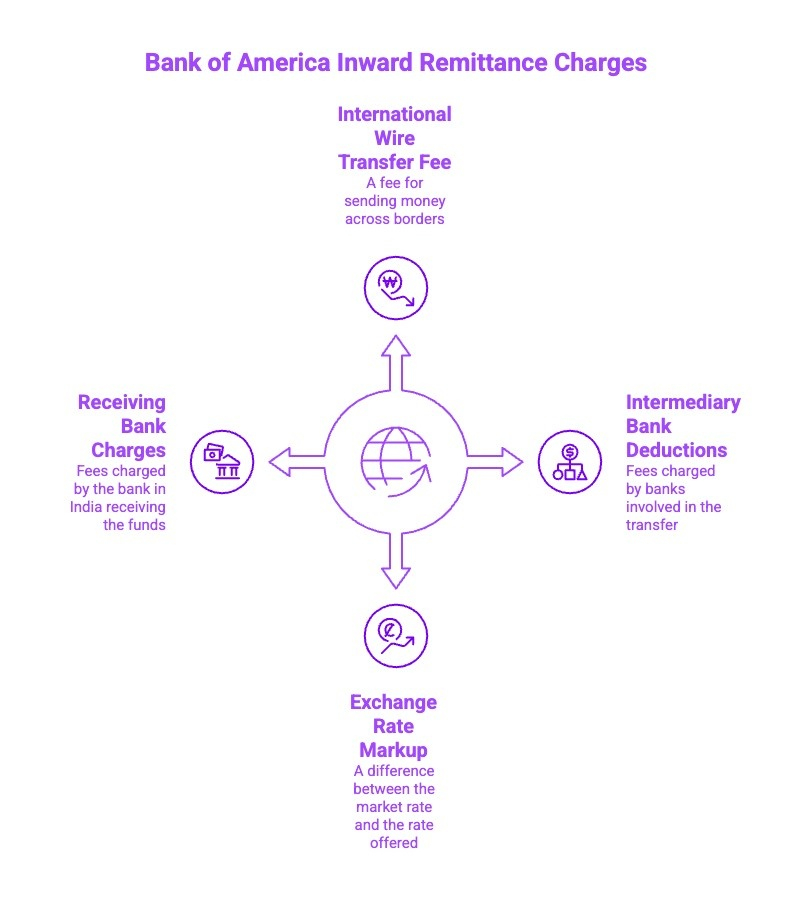
Receiving money in India through a Bank of America transfer can involve multiple layers of cost. Not all charges have the same impact. Some are small and predictable. Others can significantly reduce the final amount credited.
The biggest confusion usually happens when the sender wires a specific amount, but the recipient receives less than expected without clear notification of where the deductions occurred.
Here are the key Bank of America inward remittance charges, ranked by impact:
1. Exchange Rate Markup – Highest Impact
This is usually the largest hidden cost. The USD to INR conversion rate applied is often lower than the mid market rate. Even a one to two percent difference can reduce the final INR amount by a noticeable margin, especially on larger transfers.
2. Intermediary Bank Deductions – Variable Impact
Funds may pass through one or more correspondent banks before reaching India. These banks can deduct processing fees mid route. These deductions are not always visible at the time you initiate the transfer.
3. Receiving Bank Charges in India – Situational Impact
Some Indian banks apply inward remittance handling fees depending on account type or internal policy. These are typically smaller but still affect the final credited amount.
4. International Wire Transfer Fee – Fixed and Predictable
Bank of America charges a fixed outbound wire fee when the transfer is initiated. While visible upfront, this fee is usually smaller compared to exchange rate differences.
Example:
Suppose you send USD 5,000 from the United States.
- Bank of America charges a fixed wire fee at initiation.
- The exchange rate applied is slightly below the mid market rate, reducing the INR value by more than the fixed fee itself.
- An intermediary bank deducts USD 20 during routing.
- The recipient’s Indian bank applies a small inward processing fee.
You expected the full equivalent of USD 5,000 in INR. Instead, the recipient sees a lower amount, and the deductions occurred at different stages.
That layered deduction, especially the exchange rate markup and intermediary bank fees, is what creates the common frustration:
“I sent X. Why did they receive less?”
What Are the Common Problems With Bank of America Remittance to India?
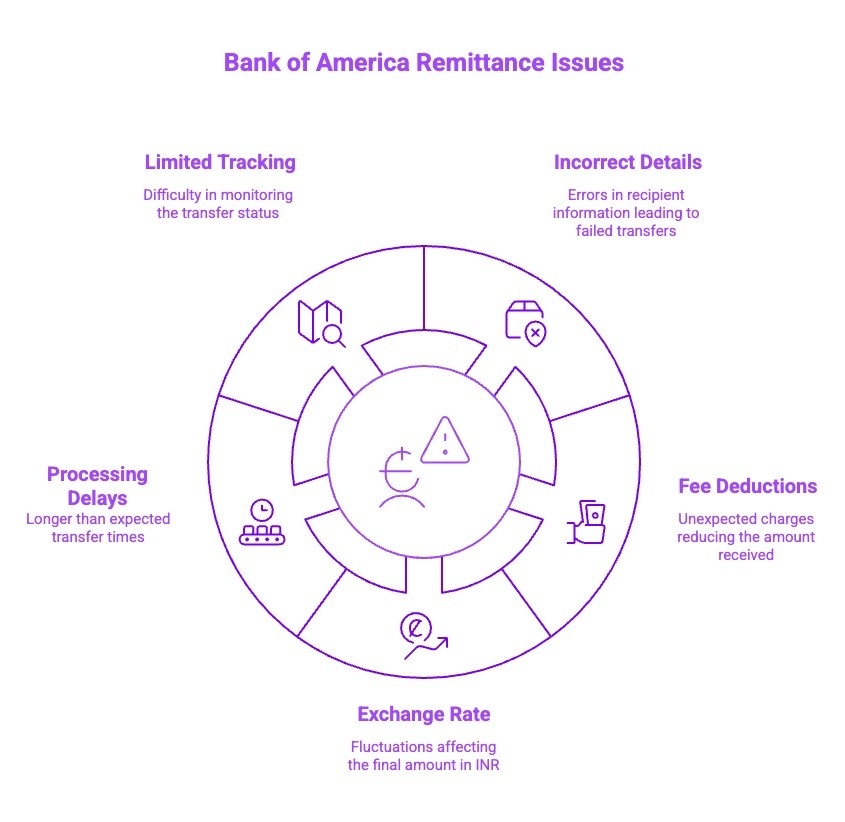
Sending money to India through a Bank of America remittance is generally secure, but issues can still arise during processing. Understanding the most common problems helps you prepare better and avoid unnecessary delays or deductions.
Here are the common problems with Bank of America remittance to India:
- Incorrect Recipient Details: Errors in the recipient’s name, bank account number, IFSC code, or SWIFT code can lead to delays, rejections, or funds being returned after processing begins.
- Unexpected Fee Deductions: Intermediary or correspondent banks may deduct fees along the way, reducing the final amount credited in India without advance notice.
- Exchange Rate Impact: Currency conversion is often handled by intermediary or receiving banks, and exchange rate markups can significantly affect the INR amount received.
- Processing Delays: Transfers may take longer due to intermediary banks, weekends, bank holidays, or manual compliance reviews.
- Limited Tracking Visibility: Real-time tracking is often limited, making it harder to know exactly where the transfer is during processing.
Being aware of these common issues helps set realistic expectations and reduces surprises when sending money to India through Bank of America.
What Is the Bank of America Remittance Limit for Transfers to India?
Sending money to India from a Bank of America account often raises questions about how much you can transfer in a single transaction or within a day. Remittance limits are not fixed and depend on several factors.
There is no universal fixed limit. Your transfer profile, account history, balance, relationship tier, and internal risk controls typically determine how much you can send at a given time.
Here are the key factors that determine the Bank of America remittance limit for transfers to India:
| Factor | How It Affects Remittance Limits |
|---|---|
| Transfer Method | Online international wire transfers usually have lower limits than branch-initiated transfers, which may allow higher amounts after verification. |
| Account Type | Personal checking, savings, and premium accounts can have different remittance limits based on account history and relationship length. |
| Daily and Transaction Limits | Bank of America applies caps on how much can be sent per transaction and per day for international remittances. |
| Compliance and Security Reviews | Large or unusual transfers may trigger additional checks, temporarily limiting or delaying the transfer until verification is complete. |
| Receiving Bank Policies | The Indian bank receiving the funds may also have restrictions on high-value inward remittances. |
Because limits vary by customer profile and transfer method, it is best to confirm your applicable remittance limit with Bank of America before initiating a transfer to India.
This variability is one of the main reasons many senders compare alternative remittance options, especially when they need predictable limits, faster approvals, or fewer transfer restrictions.
How Long Does Bank of America Remittance Processing Take for India?
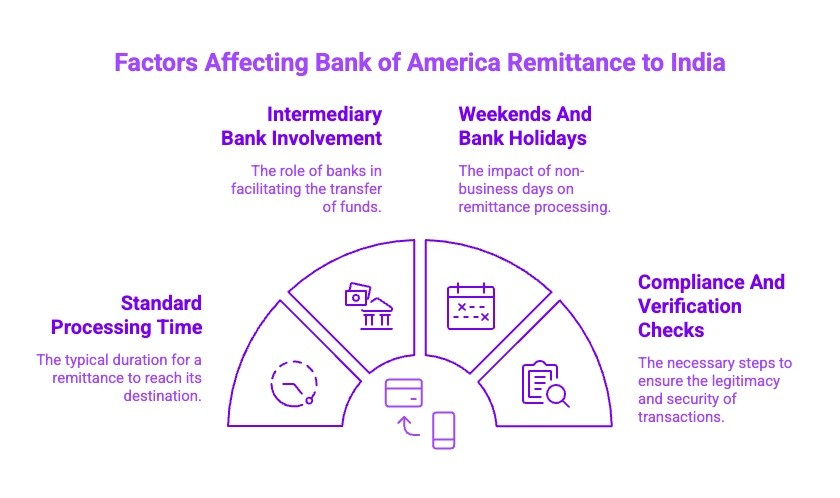
Sending money to India through a Bank of America remittance often comes with questions about timing, especially for urgent transfers. Processing time depends on several banking and compliance factors, not just when the transfer is submitted.
Here are the key factors that affect how long Bank of America remittance processing takes for India:
- Standard Processing Time: International wire transfers to India typically take two to five business days to be processed and credited, depending on routing and banking schedules.
- Intermediary Bank Involvement: Transfers often pass through one or more correspondent banks, which can add extra processing time before funds reach the recipient in India.
- Weekends and Bank Holidays: US holidays, Indian bank holidays, and weekends can slow processing, even if the transfer is initiated on time.
- Compliance and Verification Checks: Larger or unusual transfers may be delayed due to additional compliance reviews or security verification requirements.
While Bank of America remittance processing is reliable, planning ahead helps avoid delays, especially for time-sensitive transfers to India.
Can You Use a Third Party Service With a Bank of America Account to Send Money to India?
For many senders, the frustration is not just the fee. It is the unpredictability. You initiate a bank wire, but the final credited amount depends on exchange markups, intermediary deductions, and variable limits. That uncertainty is why some people look beyond traditional bank wires.
What It Is?
A regulated third party remittance service is a licensed money transfer provider that allows you to send funds internationally without initiating a traditional SWIFT wire directly through your bank. Your Bank of America account is still used to fund the transfer, but the cross border movement is handled by the remittance platform.
How It Works at a High Level?
Instead of sending a bank wire, you fund the transfer through one of these methods:
- Linking Your Bank Account via ACH: You connect your Bank of America account and authorize an ACH debit. The remittance provider pulls funds domestically, then disburses INR locally in India.
- Using a Debit Card: Some platforms allow you to fund transfers using your Bank of America debit card for quicker setup.
- Transfer Without Initiating a SWIFT Wire: The provider manages currency conversion and payout through its own banking network, avoiding the need for you to send a direct international wire.
Why People Choose This Route?
People typically choose this structure for operational reasons rather than brand preference:
- Lower Overall Cost Structure: Costs are often concentrated in the exchange rate spread rather than layered wire and intermediary deductions.
- Clearer Exchange Rate Visibility: The INR amount is usually displayed before confirmation.
- Faster Credit to Indian Accounts: Many transfers are processed within a shorter timeframe compared to traditional wires.
- More Transparent Tracking: Senders can see transfer status from funding to payout.
This model separates the funding source from the cross border settlement process, which is why it is often compared alongside direct bank wires.
How Does Bank of America Remittance Compare With Third Party Transfers to India?
By this point, the real question is not how each method works, but how they differ in structure and predictability.
| Factor | Bank of America International Wire | Regulated Third Party Remittance |
|---|---|---|
| Cost Structure | Fixed outbound wire fee plus exchange rate markup; possible intermediary deductions | Typically no SWIFT wire fee; cost mainly built into exchange rate spread |
| Exchange Rate Visibility | Final INR amount may not be fully predictable at initiation | INR amount usually shown before confirmation |
| Intermediary Deductions | Possible mid route deductions by correspondent banks | Usually no intermediary bank deductions visible to sender |
| Processing Timeline | Often two to five business days | Frequently same day or one to two business days |
| Transfer Limits | Determined by customer profile and bank risk controls | Determined by provider verification level and regulatory limits |
| Tracking Transparency | Limited visibility after wire leaves account | End to end tracking within app or dashboard |
| Best Suited For | Larger formal transfers or established banking relationships | Regular remittances requiring clarity on final credited amount |
The practical difference often comes down to predictability. Many senders compare options because they want to know exactly how much will be credited in India before confirming the transfer.
Why Should You Use Frex Instead of Bank of America Remittance to India?
If you want a faster, clearer, and more cost-effective way to send money to India, Frex is designed to remove the common pain points of traditional bank remittance. Unlike international wire transfers that involve multiple intermediary banks, Frex allows you to fund transfers directly from your US bank account with transparent pricing and predictable delivery timelines.
Frex offers competitive exchange rates, lower overall fees, and quicker credits to Indian bank accounts, making it ideal for regular family support, education expenses, or personal transfers. You can track your transfer end-to-end and know exactly how much will be received in India before confirming the transaction.
Whether you are sending money occasionally or on a recurring basis, Frex simplifies the entire remittance experience.
Get started with Frex today:
Contact us to speak with a transfer specialist, or download the app to send money to India securely in just a few steps.
Conclusion
Bank of America remittance to India offers a secure and familiar way to send money internationally, especially for those comfortable with traditional banking channels and established online banking service agreement terms. It is commonly used for family support, education expenses, and personal payments.
However, the process often involves higher fees, exchange rate markups, intermediary banks, and longer processing times. Factors such as cutoff time and the need to identify banks correctly can affect how quickly funds are credited.
For routine or time-sensitive payments, many users choose a quick way to fund third-party remittance services from their Bank of America account using a debit card as a payment method for better transparency.
Choosing the right option depends on the amount of money, urgency, and clarity over fees and exchange rates.
Frequently Asked Questions
Can I track the status of my wire transfer from Bank of America to India?
Yes. You can track an international wire through Bank of America online or via the mobile banking app. Updates usually appear within minutes of submission, showing processing status across financial institutions, although intermediary bank stages may have limited visibility.
Can I use the Bank of America mobile app to transfer money to India?
Yes. The mobile banking app lets you initiate international wires from the United States. You will need accurate recipient information, including the recipient’s name and account details. Confirmations may be shared in the app or by text message to your registered mobile number.
Are there daily or monthly limits for sending remittances to India from Bank of America?
Yes. Daily and per-transaction limits apply to international wires. Limits vary by account information, Preferred Rewards status, and compliance checks and are set at the bank’s sole discretion, especially for larger or unusual transfers.
What exchange rate does Bank of America use for remittances to India?
Bank of America usually sends wires in US dollars. The exchange rate is applied by intermediary or receiving banks based on their bank information and may include a markup, which can affect how much reaches the recipient’s bank account.
Do I need to visit a branch, or can I send money to India online through Bank of America?
Most customers can send money online using mobile banking or a new browser tab on desktop banking. Branch visits are generally not required unless additional verification is needed for high-value transfers or updated account details.
Do I get charged for receiving international wire transfers?
Bank of America does not charge recipients in India directly. However, the receiving bank or intermediary financial institutions may deduct inward remittance fees based on local policies and the recipient’s bank account type.
What is the maximum amount I can transfer from Bank of America?
The maximum transfer amount depends on your account type, wire routing number setup, and compliance review. Larger transfers may require extra verification or authorization code approval before funds are released.
Are there any special forms or documents required for international wire transfers to India at Bank of America?
Most wires only require the basic recipient’s information, account details, and bank information. For larger transfers, additional documentation may be requested under service agreement terms or US compliance rules to prevent robo de identidad and fraud.




Leave a Reply