





Key Highlights
- A cross-border fee is not a single charge; it includes transfer fees, exchange rate markups, intermediary deductions, and receiving bank charges.
- The highest hidden cost usually comes from exchange rate markups, not the upfront fee.
- The real cost of a transfer is the difference between what you send and what your recipient receives.
- Fees are often unclear because multiple banks and systems are involved, each adding its own charges.
- Comparing providers based on final payout and exchange rate gives a more accurate cost than just looking at fees.
- Using fewer intermediaries and avoiding card-based transfers can help reduce overall costs.
- Frex shows the exact payout upfront, avoids hidden deductions, and makes USD to INR transfers more predictable.
You send money abroad expecting your recipient to get the full amount, but what arrives is less. It is a frustrating but common outcome of how cross-border fee structures work, where costs are not always shown clearly at the start.
Most people assume the fee they see is the only charge. In reality, a cross-border transfer fee is made up of multiple layers, such as exchange rate markups, intermediary deductions, and receiving bank fees. These hidden elements increase the total cost of cross-border payments and make it harder to know what you are actually paying.
In this guide, you will get a clear breakdown of where these fees come from and how they affect your transfer. You will also learn how to reduce unnecessary costs and choose transparent options like Frex for sending USD to INR with more certainty and control.
What Is a Cross-Border Fee?
A cross-border fee is the total cost charged when you send money from one country to another. It typically includes the transfer fee, currency conversion charges, and any additional costs applied by banks or payment networks.
Although it may appear as a single fee, it is often a combination of visible and hidden charges that affect the final amount your recipient receives.
Want more clarity before you send? Frex helps you see the real USD-to-INR payout upfront.
What Are the Different Types of Cross-Border Fees?
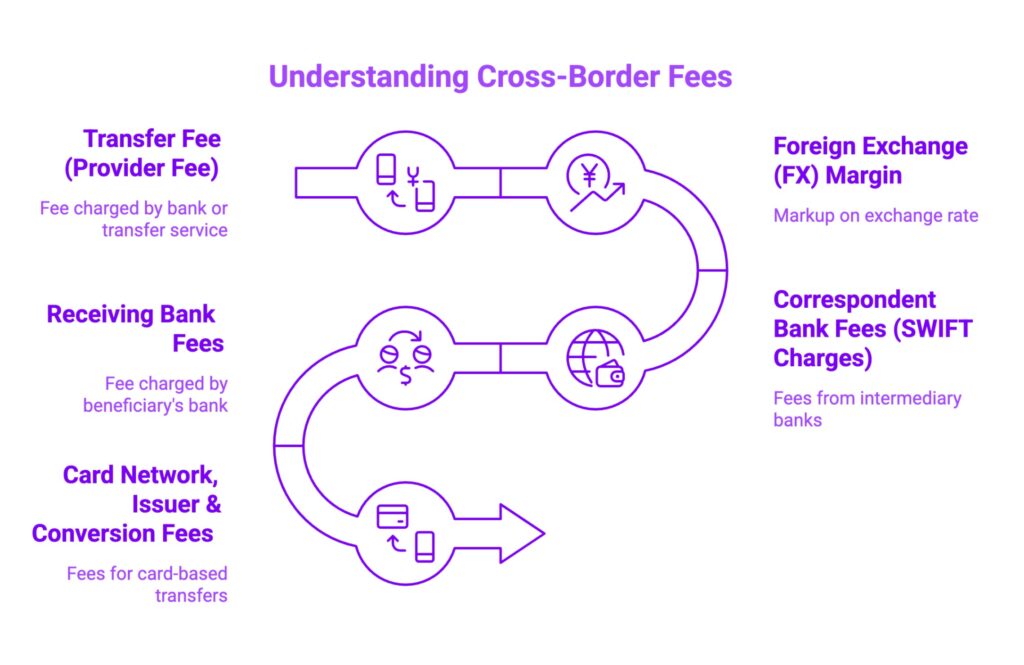
A cross-border fee is made up of multiple charges applied across different layers of the payment process. Depending on the provider, route, and payment method, these fees can be split, bundled, or hidden inside the exchange rate.
1. Transfer Fee (Provider Fee)
This is the fee charged by your bank or transfer service to process the payment. It may be fixed or variable and is often called a cross-border transfer fee. Traditional banks typically charge higher fixed fees, especially for wire transfers.
2. Foreign Exchange (FX) Margin
Instead of charging a higher visible fee, many providers make money by marking up the exchange rate. The difference between the mid-market rate and the offered rate is effectively a hidden cost, and often the largest one in international transfers.
3. Correspondent Bank Fees (SWIFT Charges)
Most international bank transfers use the SWIFT network, where funds pass through intermediary banks. Each bank in the chain can deduct a fee. These charges are not standardized and are rarely disclosed upfront, making them one of the least predictable parts of cross-border payment fees.
4. Receiving Bank Fees
The beneficiary’s bank may charge for handling incoming international transfers. This fee is deducted after the money arrives, which is why recipients often receive less than expected.
5. Card Network, Issuer & Conversion Fees
When you fund a transfer using a debit or credit card, extra costs can apply. These include network processing fees, foreign transaction charges, and sometimes additional currency conversion fees from the issuing bank. In some cases, the issuer may also use its own exchange rate, which can increase the total cost.
Key insight: These charges are often split across multiple entities, so they are not always visible upfront. To understand what you are truly paying, look beyond the advertised fee and consider the full fee chain.
A big part of hidden cross-border fees comes from exchange rates. If you want to reduce that impact, here’s how to avoid currency exchange fees.
What Is the Real Cost of Cross-Border Payments?
The real cost of sending money internationally is rarely equal to the fee shown at checkout. What matters is the final amount your recipient receives, not just the upfront charge.
Real cost formula: Real cost = Amount sent – Amount received
Example:
You send $1,000
- Upfront fee: $5
- Exchange rate: 1 USD = ₹82 (mid-market rate: ₹83)
- Expected amount at mid-market: ₹83,000
- Actual converted amount: ₹82,000
- Receiving bank fee: ₹500
Final amount received: ₹81,500
Effective loss: ₹1,500 (rate markup + bank fee) + $5 fee
Even though the visible fee is just $5, the true cost is much higher once hidden charges are factored in.
So, why does this happen?
Many providers advertise low fees but build margins into the exchange rate. Others route transfers through intermediary banks, which can introduce additional deductions. This is why two transfers with the same upfront fee can deliver very different final amounts.
What to actually compare?
- The exchange rate vs the mid-market rate
- The final amount the recipient will receive
- Any intermediary or receiving bank deductions
Bottom line: The real cost is not what you pay to send money, but how much value is lost between sending and receiving.
Hidden fees add up quickly. Frex helps you see exactly how much INR will be delivered before you send.
Where Are Cross-Border Fees Applied (Step-by-Step)?
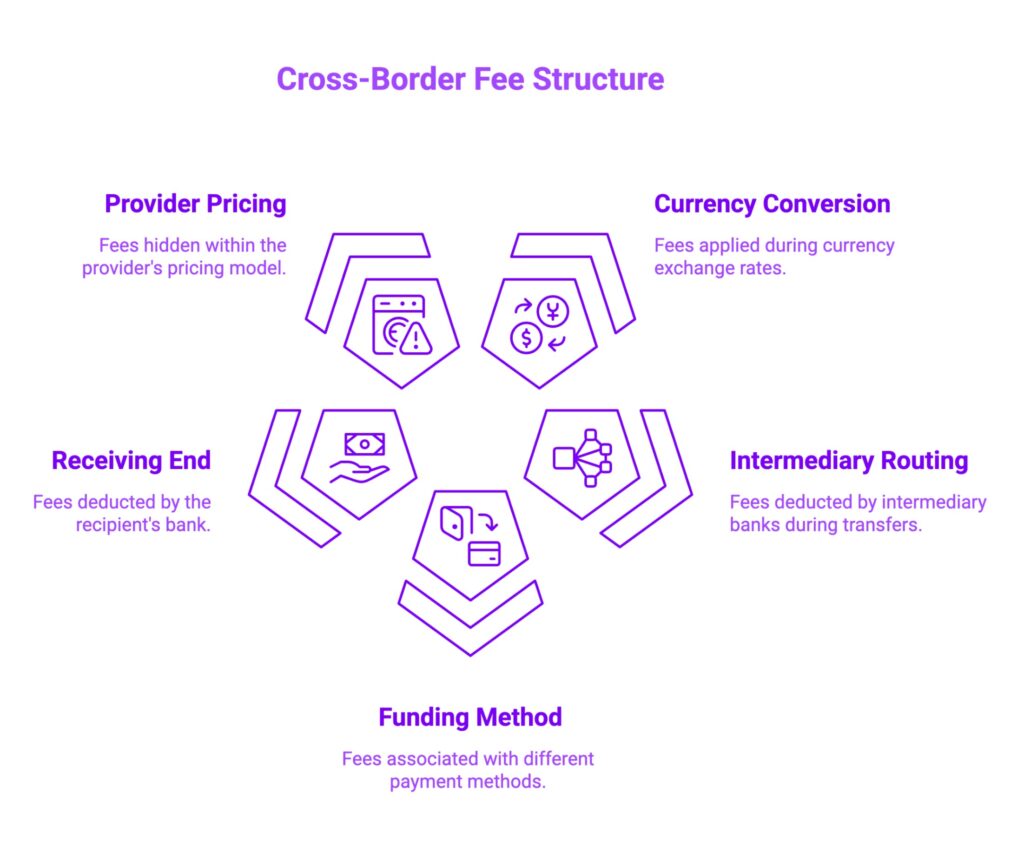
Cross-border fees are not charged in one place. They appear at different stages of the transaction depending on how the money is processed, converted, and delivered. This is why the final amount often differs from what you expect.
1. At Currency Conversion
When converting USD to INR, providers apply their own exchange rate.
For example, if the mid-market rate is 1 USD = ₹83 but you are offered ₹82, the ₹1 difference per dollar acts as a hidden fee.
2. During Intermediary Routing
Transfers sent through traditional banking networks may pass through intermediary banks.
For example, a correspondent bank can deduct a handling fee before the funds reach the recipient, often without upfront visibility.
3. When Funding the Transfer
Your payment method affects the total cost.
For example, using a credit card can trigger additional charges from the card network and issuing bank, making it more expensive than a bank transfer.
4. At the Receiving End
Fees can also apply on the recipient’s side.
For example, the receiving bank may deduct a fixed fee before crediting the funds, reducing the final amount received.
5. Within the Provider’s Pricing Model
Some providers shift costs away from upfront fees.
For example, a service may advertise “zero transfer fees” but apply a wider exchange rate margin instead.
Cross-border payments involve multiple layers, and each step can introduce a cost. The more intermediaries involved, the harder it becomes to see the full picture.
To fully understand where fees come from, it helps to look at how a cross-border money transfer service works from start to finish.
Why Are Cross-Border Fees Often Hidden?
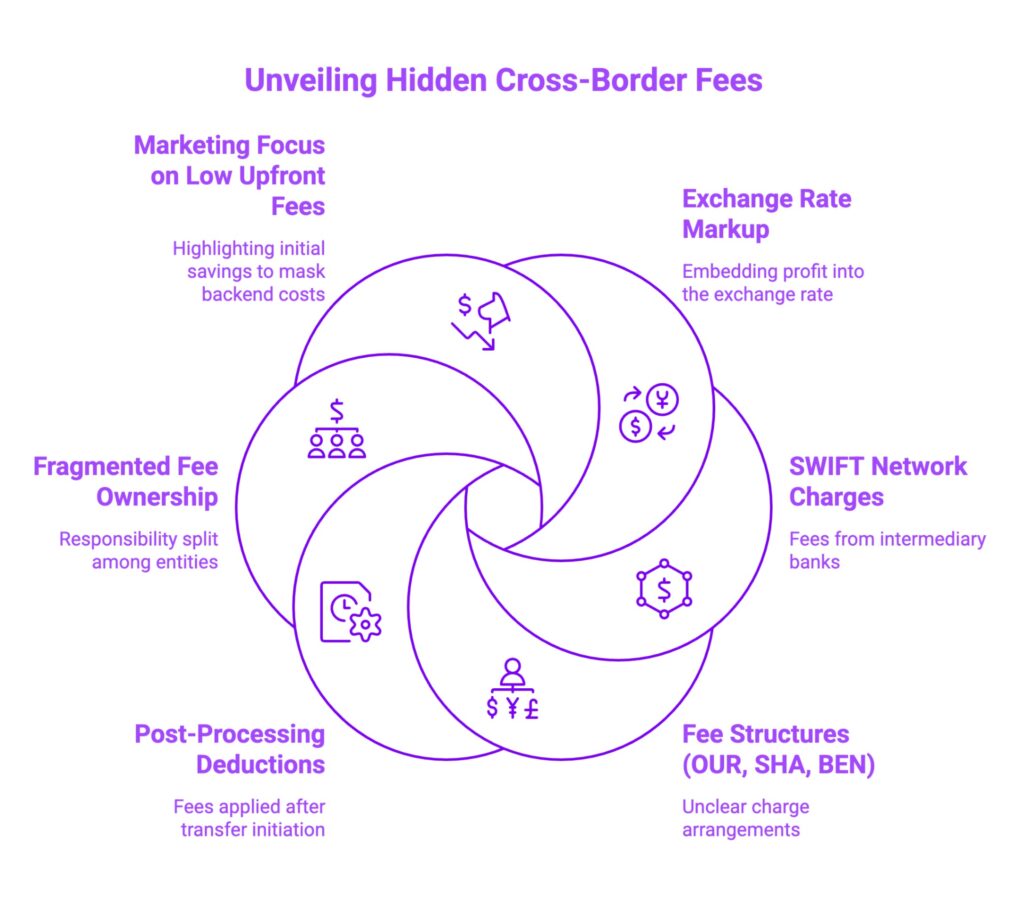
Cross-border fees feel hidden because of how international payments are structured. A single transfer can involve multiple systems, banks, and pricing layers, each applying its own charge. Since these costs are not always shown together, the total fee becomes difficult to see upfront.
Here are the main reasons why:
1. Exchange Rate as a Pricing Layer
Many providers do not rely heavily on upfront fees. Instead, they embed their margin into the exchange rate. Because users rarely compare the offered rate with the mid-market rate, this becomes one of the least visible yet most impactful costs in a transfer.
2. SWIFT and Correspondent Banking Model
Traditional international transfers often move through the SWIFT network, where funds pass between correspondent banks that hold accounts with each other. Each intermediary can deduct a handling fee based on internal agreements, and these charges are not standardized or disclosed in advance.
3. OUR, SHA, BEN Fee Structures
International wire transfers can follow different charge arrangements:
- OUR: The sender pays all fees
- SHA: Fees are shared between sender and receiver
- BEN: The recipient pays most of the fees
These options are not always clearly explained during the transfer process, which can lead to unexpected deductions.
4. Post-Processing Deductions
Some fees are applied after the transfer is initiated or even after it reaches the destination country. This includes intermediary bank charges and receiving bank fees, meaning the exact final amount is not always guaranteed upfront.
5. Fragmented Fee Ownership
No single entity controls the entire transaction. The sending bank, payment network, intermediary banks, and receiving bank may all apply their own charges. Because responsibility is split, there is no unified breakdown presented to the user.
6. Marketing Focus on Low Upfront Fees
Many providers highlight low or zero upfront fees to stay competitive, while recovering costs through less visible components like exchange rate margins or backend charges. This creates a pricing structure that appears simple but is not fully transparent.
Cross-border fees appear hidden, not because they are absent, but because they are distributed across multiple stages, entities, and pricing layers, making the true cost difficult to see in one place.
If your transfer is taking longer than expected, understanding US to India wire transfer time can help you see where delays come from.
Banks vs Modern Platforms: Which Is Cheaper for Cross-Border Transfers?
When comparing options, the difference becomes clearer when you look at how each handles fees, exchange rates, and transparency.
Here’s a table to simplify the comparison:
| Factor | Traditional Banks | Modern Transfer Platforms |
|---|---|---|
| Upfront Fees | Often, higher fixed fees for international wires | Lower or clearly defined fees |
| Exchange Rate | Includes hidden markup on the rate | Closer to real or market-linked rates |
| Intermediary Charges | Common due to SWIFT routing | Usually minimized or avoided |
| Fee Transparency | Limited visibility into total cost | Clear breakdown of total cost |
| Final Amount Clarity | Not always guaranteed upfront | Shown before you send |
| Speed | Slower due to multiple banks involved | Faster due to streamlined systems |
| Total Cost Predictability | Uncertain due to hidden and variable charges | More predictable with upfront visibility |
This comparison highlights a key shift in how international transfers are handled. Traditional systems tend to distribute costs across multiple layers, while newer platforms aim to make pricing more predictable and easier to understand.
How Can You Reduce Cross-Border Payment Fees?
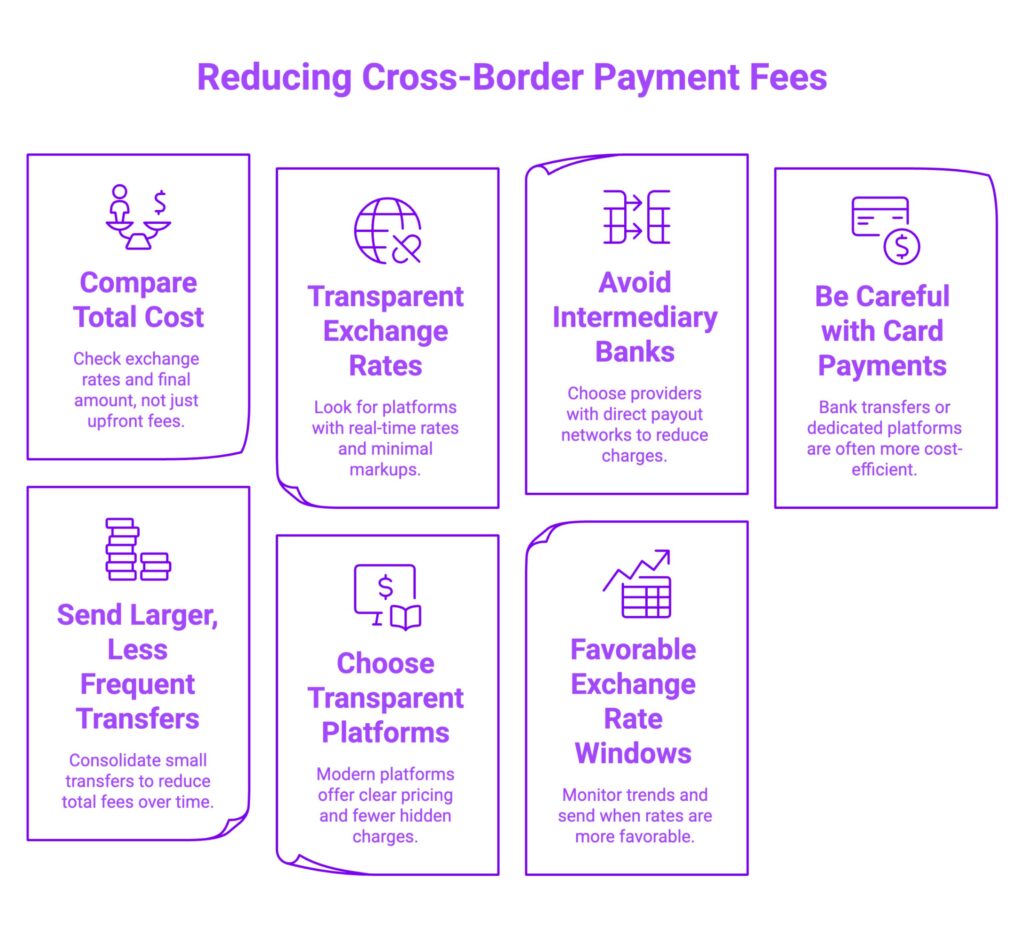
Reducing fees starts with understanding where the costs come from and choosing providers that are transparent about pricing. Small changes in how you send money can make a noticeable difference, especially for frequent transfers.
1. Compare the Total Cost, Not Just the Fee
Do not rely only on the upfront fee shown during checkout. Always check the exchange rate being offered and the final amount your recipient will receive. This gives you a clearer picture of the total cost.
2. Choose Providers with Transparent Exchange Rates
Look for platforms that use real or near-real-time exchange rates without large markups. A better rate often saves more money than a lower transfer fee.
3. Avoid Intermediary-Heavy Transfer Routes
Traditional bank transfers may involve multiple intermediary banks, which can add unpredictable charges. Choosing providers with direct payout networks can help reduce these deductions.
4. Be Careful with Card Payments
Using debit or credit cards for international transfers can increase costs due to additional processing and foreign transaction charges. Bank transfers or dedicated platforms are often more cost-efficient.
5. Send Larger, Less Frequent Transfers
If possible, consolidating multiple small transfers into fewer larger ones can reduce the total fees paid over time, especially when fixed charges are involved.
6. Choose Transparent Transfer Platforms
Modern transfer platforms focus on clear pricing and fewer hidden charges. Options like Frex help you see the final payout upfront, making USD-to-INR transfers more predictable and cost-efficient.
7. Send During Favorable Exchange Rate Windows
If your transfer is not urgent, monitor exchange rate trends and send when rates are more favorable. Even small improvements in the rate can lead to meaningful savings on larger amounts.
Reducing cross-border fees is not about finding the lowest upfront charge, but about optimizing the entire transfer by choosing the right timing, method, and provider to maximize the amount received.
Ready to avoid hidden transfer costs? Download the Frex app and send USD to INR with more clarity and control.
Why Frex Is a Smarter Way to Send USD to INR?
By now, it’s clear that most cross-border fees are not just high, they’re unpredictable. You send money thinking you know the cost, but the final amount tells a different story.
That’s exactly the problem we built Frex to solve.
Instead of adding layers of hidden charges, we focus on making the entire transfer simple and transparent from the start. So you are not left guessing what happens to your money after you hit send.
Here’s how we do it differently:
- You know the final amount before you send: No surprises at the receiving end. We show you exactly how much INR will be delivered, so you are not left calculating or second-guessing.
- No hidden exchange rate tricks: Many providers hide their fees inside the exchange rate. We don’t. You get competitive rates without inflated margins eating into your transfer.
- No unexpected deductions along the way: Traditional transfers can lose money through intermediary banks. We remove those unnecessary layers so your transfer stays intact.
- Built for people sending money to India regularly: Whether you are supporting family, managing expenses, or moving funds, we have designed Frex specifically for USD to INR transfers.
- Simple, fast, and predictable: The goal is not just lower fees. It is giving you control. You know what you are paying, how long it will take, and what your recipient will get.
Frex is not just another transfer option. It is a way to avoid the hidden costs that most people only realize after the money is already sent.
Download the Frex app today and start sending money with clarity, control, and no hidden fees.
Final Words
Cross-border fees are not just about what you are charged upfront. They are about what gets lost between sending and receiving. Once you understand how these fees are layered across exchange rates, intermediaries, and processing systems, it becomes clear why international transfers often feel unpredictable.
The real shift is not just finding a cheaper option, but choosing a more transparent one. When you can see the full cost and the exact payout before you send, you move from guessing to making informed decisions.
As international payments become more common, clarity matters more than ever. The more you understand how cross-border fees work, the easier it becomes to avoid unnecessary costs and ensure your money reaches exactly where it should, without surprises.
Frequently Asked Questions
What does the new 1% remittance fee mean for cross-border payments?
A 1% remittance fee adds a direct cost to international transactions, calculated on the transaction amount. For transfers across international borders, it impacts cash flow, especially when converting foreign currency or moving funds between financial institutions.
What is the difference between a cross-border fee and a cross-border assessment fee?
A cross-border fee is charged by a payment provider or bank for international transactions. A cross-border assessment fee is applied by credit card networks like American Express based on the location of the card and processing across different countries.
How much is a cross-border fee?
A cross-border fee varies by payment provider and type of transaction. It may include a flat fee, a percentage of the transaction amount, FX fees, and a currency conversion fee. Combined, these costs can significantly affect global payments and profit margins.
Why are cross-border payments so expensive?
Cross-border payments involve multiple financial institutions, payment rails, and compliance with international regulations. Costs include currency conversion fees, wire transfer fees, and payment processing charges, all of which increase operational costs and impact the bottom line.
Who typically pays the cross-border fee in an international payment, the sender or the receiver?
In most card transactions, the sender pays the foreign transaction fee through their bank account or credit card. In some cases, payment platforms or merchants pass cross-border fees to international customers depending on pricing, local regulations, and customer experience.




Leave a Reply