





Key Highlights
- Cross-border payments help businesses, freelancers, and global teams send and receive money internationally for payroll, invoices, vendor payments, and online sales.
- The best platforms offer faster transfers, lower fees, better exchange rates, and tools like payment tracking, multi-currency accounts, and compliance support.
- Top options in 2026 include Frex, Wise, Payoneer, PayPal, Stripe, Airwallex, Nium, EBANX, Ripple, and Skydo, each built for different use cases.
- Choosing the right provider depends on your transfer speed needs, fees, supported countries, integrations, and business model.
- Common challenges include managing multiple payment methods, handling local regulations, and scaling payment operations across countries.
- New technologies like stablecoins, blockchain, and local payment rails are making international transfers faster and more efficient.
- Frex offers near-instant transfers, competitive exchange rates, low fees, and direct transfers to major Indian bank accounts.
Growing globally is exciting, but international payments can get messy fast. Hidden fees, poor exchange rates, and slow transfers can eat into profits and hurt cash flow. With trillions moving across borders every year, businesses need faster and smarter payment solutions.
As your business grows, so do the challenges. Whether you’re collecting payments from global customers, paying overseas vendors, or receiving freelance income, delays and extra costs can add up quickly.
The right cross-border payments company can fix that. In this blog, we’ll compare the best options and help you choose the right one for faster, easier, and more affordable global payments.
What Are Cross-Border Payments?
Cross-border payments are transactions where money is sent or received between individuals or businesses in different countries.
These payments are used for things like paying international vendors, receiving overseas customer payments, managing global payroll, and sending freelance invoices. Modern solutions make these transactions faster, cheaper, and easier to track.
What Are the Benefits of Using Cross-Border Payment Services?
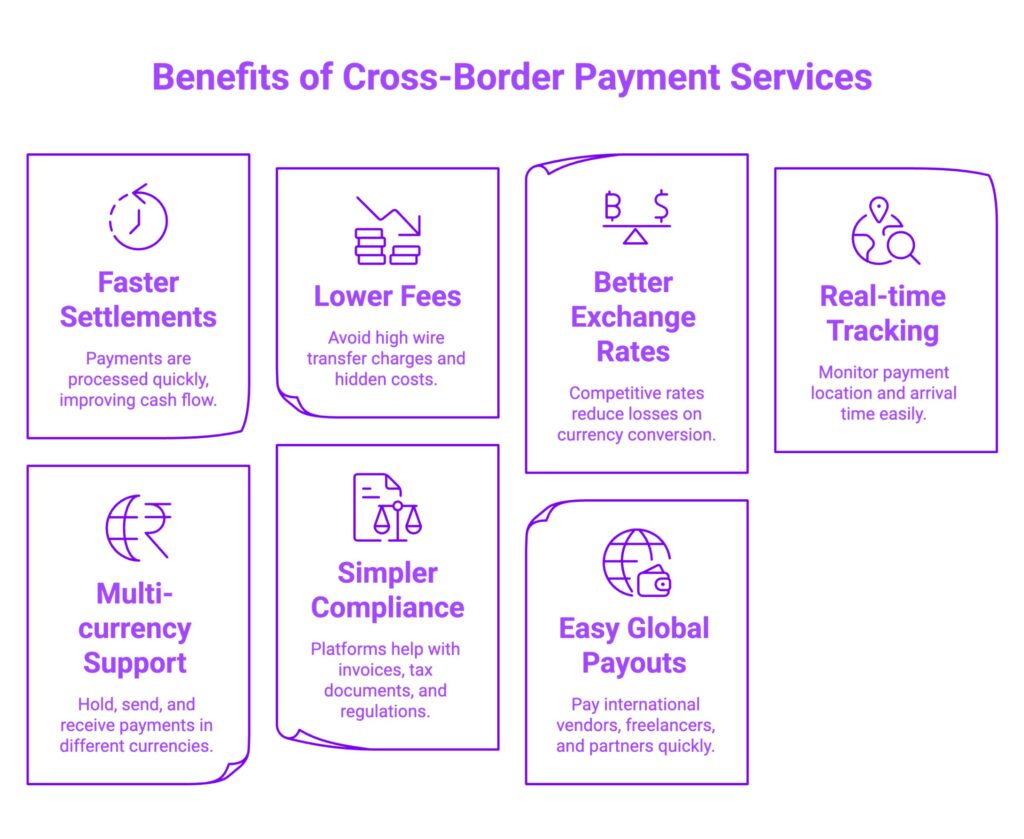
Managing international transactions through traditional banks can be slow, expensive, and frustrating. Modern payment solutions are designed to make global transactions faster, more affordable, and easier to manage as your business grows.
Here are some key benefits:
- Faster settlements: Many providers process payments in hours or within 1–2 business days, helping improve cash flow.
- Lower fees: You can avoid high wire transfer charges and reduce hidden costs with more transparent pricing.
- Better exchange rates: Many platforms offer competitive or mid-market rates, so you lose less money on currency conversion.
- Real-time tracking: Easily monitor where your payment is and when it will arrive.
- Multi-currency support: Hold, send, and receive payments in different currencies without constant conversions.
- Simpler compliance: Some platforms help with invoices, tax documents, and regulatory requirements.
- Easy global payouts: Pay international vendors, freelancers, employees, or partners quickly and efficiently.
Want to understand the process better? Read our guide on choosing the right cross-border money transfer service.
Cross-Border Payment Platforms at a Glance
If you’re short on time, here’s a quick snapshot of the 10 best cross-border payment providers and what they’re best known for.
| Platform | Best For | Key Strength |
|---|---|---|
| Frex | U.S. to India transfers | Near-instant transfers with competitive rates |
| Wise | Freelancers & SMBs | Mid-market exchange rates and transparent fees |
| Payoneer | Marketplace sellers | Global receiving accounts and mass payouts |
| PayPal | Small businesses | Trusted global brand and easy payments |
| Stripe | SaaS & eCommerce | Developer-friendly APIs and subscriptions |
| Airwallex | Growing businesses | Multi-currency accounts and FX management |
| Nium | Enterprises & fintechs | Real-time payouts and API-first infrastructure |
| EBANX | Emerging markets | Local payment methods in Latin America and beyond |
| Ripple | Banks & institutions | Blockchain-based global settlements |
| Skydo | Indian businesses | Lower forex markup and export compliance |
Which Are the Top 10 Cross-Border Payments Companies In 2026?
The right provider depends on your business type, payment volume, and where you send or receive money. Some platforms are ideal for freelancers and small businesses, while others are built for global eCommerce brands or enterprises.
Here are some of the best options to consider:
1. Frex
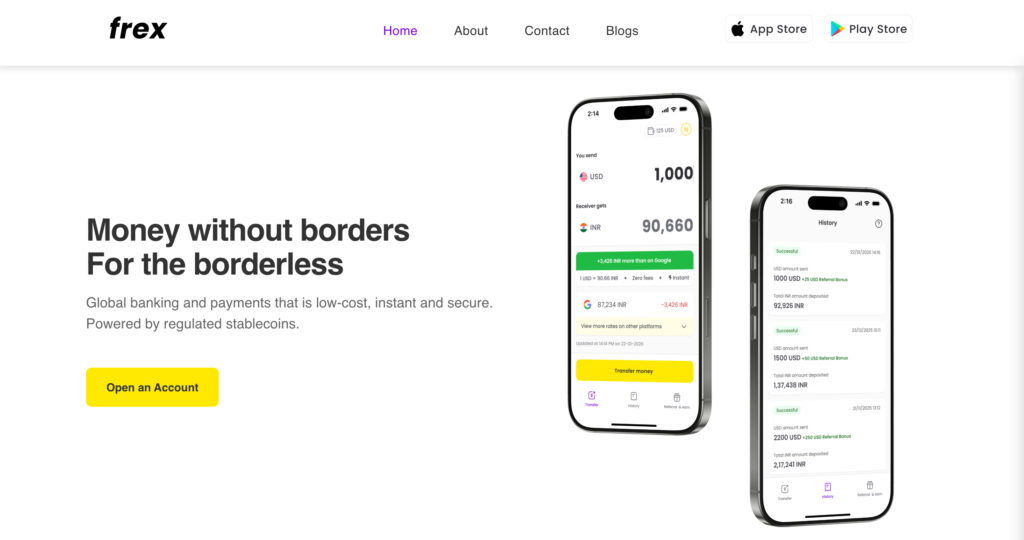
Sending money internationally can often feel slow, expensive, and unnecessarily complicated. Between hidden fees, weak exchange rates, and long processing times, traditional banks can make global transfers frustrating. At Frex, we make international payments faster, simpler, and more cost-effective.
We help individuals and businesses move money across borders with near-instant transfers, competitive exchange rates, and a secure payment experience. By using regulated stablecoins and local banking rails, we reduce delays and make sure your money reaches the right place quickly and safely.
Why We Stand Out:
- Near-instant international transfers: Send money in minutes, not days, so your recipient gets funds faster.
- Competitive exchange rates: Get more value on every transfer with rates designed to help you save compared to traditional banks.
- Low or zero transfer fees: Avoid excessive charges and enjoy transparent pricing with little to no extra fees.
- Low minimum transfer amount: Send as little as $2, making it easy to handle small urgent payments or everyday family support without waiting to bundle transfers.
- Secure transfers powered by regulated stablecoins: Our technology helps ensure faster, safer, and more reliable transactions.
- Easy tracking through our mobile app: Monitor your transfer status in real time and stay updated every step of the way.
- Direct transfers to major Indian bank accounts: Send money directly to supported bank accounts in India without extra hassle.
Best For: NRIs, freelancers, remote workers, and businesses looking for fast, affordable, and secure international transfers.
Ready to make your next international transfer simple and stress-free? Download Frex today and start sending money smarter.
2. Wise
Wise is one of the most popular international money transfer platforms, known for its transparent pricing and real mid-market exchange rates. It helps individuals and businesses send, receive, and hold money in multiple currencies without the high fees often charged by traditional banks. With fast transfers and a user-friendly interface, Wise is a trusted option for global payments.
Why Wise Stands Out:
- Real mid-market exchange rates with no hidden markup
- Transparent, upfront transfer fees
- Multi-currency account for holding and managing global funds
- Fast international transfers to 70+ countries
- Local bank details in multiple currencies
- Easy-to-use web and mobile platform
Best For: Freelancers, remote workers, small businesses, and anyone looking for low-cost international transfers.
Not sure how much you can send with Wise? Here’s everything you need to know about Wise transfer limits.
3. Payoneer
Payoneer is a trusted global payment platform that helps businesses, freelancers, and online sellers send and receive international payments easily. It is widely used by marketplace sellers and service providers who need a reliable way to collect payments from clients and platforms worldwide.
Why Payoneer Stands Out:
- Global receiving accounts in multiple currencies
- Fast and secure international transfers
- Mass payouts for businesses and marketplaces
- Integrations with platforms like Amazon, Upwork, and Fiverr
- Easy withdrawal to local bank accounts
- Built-in billing and payment request tools
Best For: Freelancers, marketplace sellers, agencies, and businesses managing global payments and payouts.
4. PayPal
PayPal is one of the most widely recognized global payment platforms, making it easy for individuals and businesses to send, receive, and manage international payments. Its global reach, trusted brand, and simple checkout integrations make it a popular choice for online businesses and freelancers handling overseas transactions.
Why PayPal Stands Out:
- Supports international payments in multiple currencies
- Easy checkout integration for eCommerce businesses
- Simple invoicing and payment request tools
- Strong global brand recognition and customer trust
- Buyer and seller protection features
- Fast access to funds through linked bank accounts
Best For: Freelancers, small businesses, and eCommerce brands looking for a simple and trusted international payment solution.
5. Stripe
Stripe is a powerful payment platform built for online businesses, SaaS companies, and eCommerce brands that need to accept and manage international payments at scale. Known for its developer-friendly APIs and flexible tools, Stripe makes it easy to handle everything from one-time payments to subscriptions and global payouts.
Why Stripe Stands Out
- Accept payments in 135+ currencies
- Powerful APIs for custom payment integrations
- Built-in subscription billing and invoicing tools
- Global payouts for businesses and marketplaces
- Advanced fraud prevention and security tools
- Seamless integrations with websites and apps
Best For: SaaS companies, startups, marketplaces, and eCommerce businesses that need scalable global payment infrastructure.
6. Airwallex
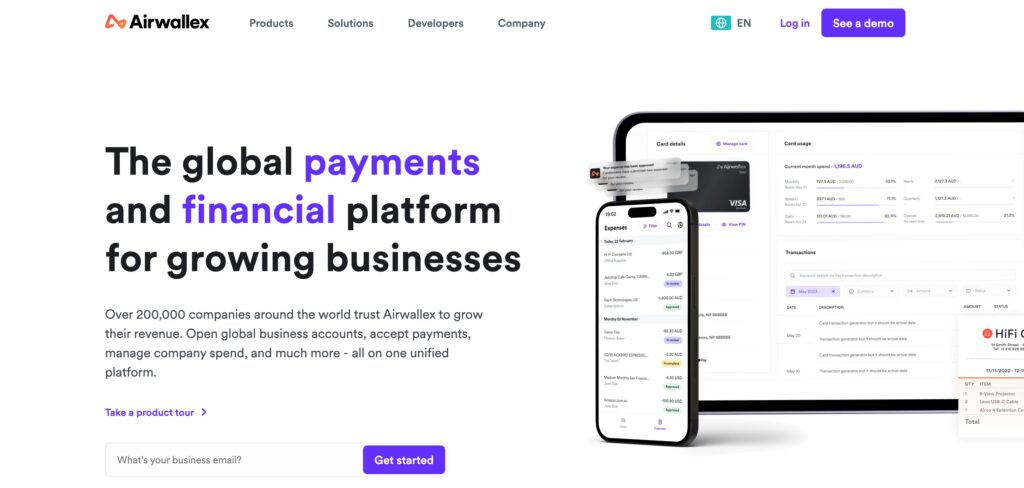
Airwallex is a global financial platform designed to help businesses manage international payments, multi-currency accounts, and global spending in one place. It offers businesses more control over foreign exchange, cross-border transactions, and expense management, making it a strong choice for growing companies operating internationally.
Why Airwallex Stands Out:
- Multi-currency business accounts
- Competitive foreign exchange rates
- Global transfers to 150+ countries
- Virtual and physical cards for business spending
- API integrations for payments and financial operations
- Expense and treasury management tools
Best For: Startups, scaling businesses, and enterprises managing global payments and multi-currency operations.
7. Nium
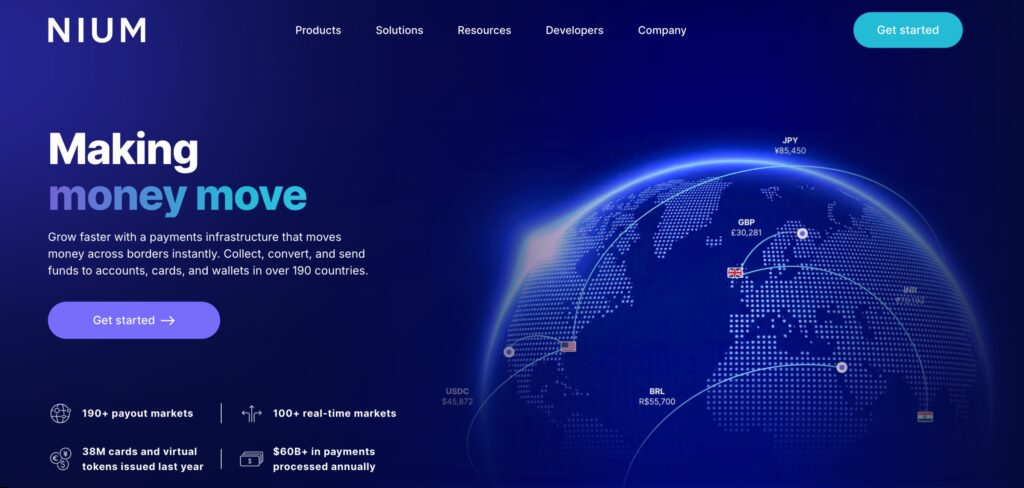
Nium is an enterprise-focused global payments platform built for businesses that need fast, reliable, and scalable international payout solutions. Its API-first infrastructure helps companies automate cross-border transactions, manage real-time payouts, and embed payment capabilities into their products or services.
Why Nium Stands Out:
- Real-time global payouts
- API-first infrastructure for seamless integrations
- Supports transfers to 190+ countries
- Multi-currency payment capabilities
- Card issuance and embedded finance solutions
- Enterprise-grade compliance and security
Best For: Enterprises, fintech companies, and global businesses that need scalable payout and embedded finance solutions.
8. EBANX
EBANX is a global payments platform that helps international businesses accept payments in emerging markets, especially across Latin America, Africa, and parts of Asia. It specializes in local payment methods, making it easier for global merchants to reach customers in regions where traditional card payments are less common.
Why EBANX Stands Out:
- Access to local payment methods in emerging markets
- Strong coverage across Latin America and beyond
- Supports alternative payment options beyond cards
- Easy integration for global merchants
- Helps improve payment acceptance rates
- Localized checkout experiences for customers
Best For: Global eCommerce businesses and merchants looking to expand into emerging markets.
9. Ripple
Ripple is a blockchain-based payment network designed to make international money transfers faster, cheaper, and more efficient for financial institutions and enterprises. By using blockchain technology for settlement, Ripple reduces the delays and costs associated with traditional cross-border banking systems.
Why Ripple Stands Out:
- Near-instant global settlements
- Lower transaction costs compared to traditional banking
- Blockchain-powered payment infrastructure
- Strong security and transparency
- Supports enterprise-scale international transfers
- Designed for financial institutions and payment providers
Best For: Banks, financial institutions, and enterprises looking for faster and more efficient global payment infrastructure.
10. Skydo
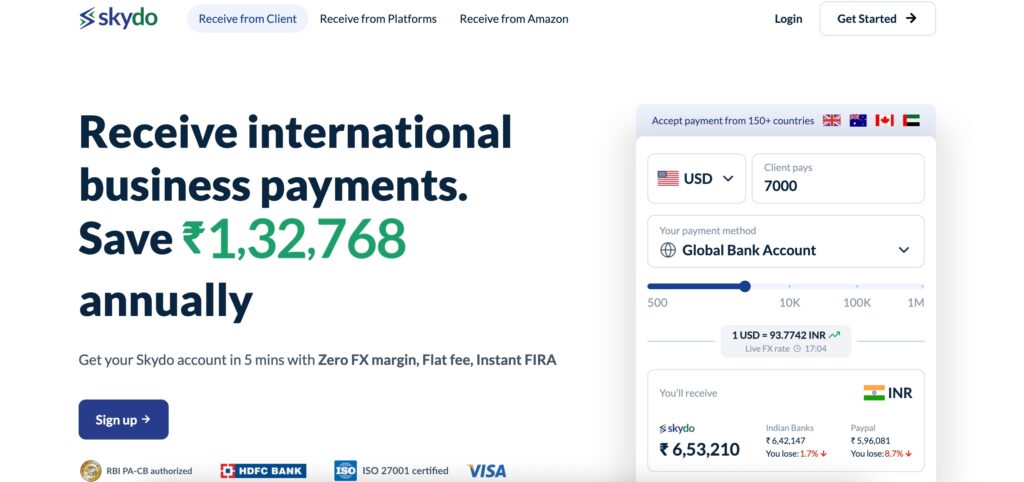
Skydo is a cross-border payments platform built for Indian freelancers, exporters, agencies, and businesses receiving international payments. It focuses on helping users collect overseas payments with lower forex markups, faster settlements, and simplified export compliance.
Why Skydo Stands Out:
- Virtual foreign bank accounts for easy collections
- Lower forex markup and transparent pricing
- Faster international payment settlements
- Automated FIRA and export documentation
- Easy tracking and payment reconciliation
- Built specifically for Indian businesses and freelancers
Best For: Indian freelancers, exporters, agencies, and businesses receiving international payments.
Want to compare your options before sending? Check out our guide to the top digital remittance services for USD to INR transfers.
How Do You Choose the Right Cross-Border Payments Company?
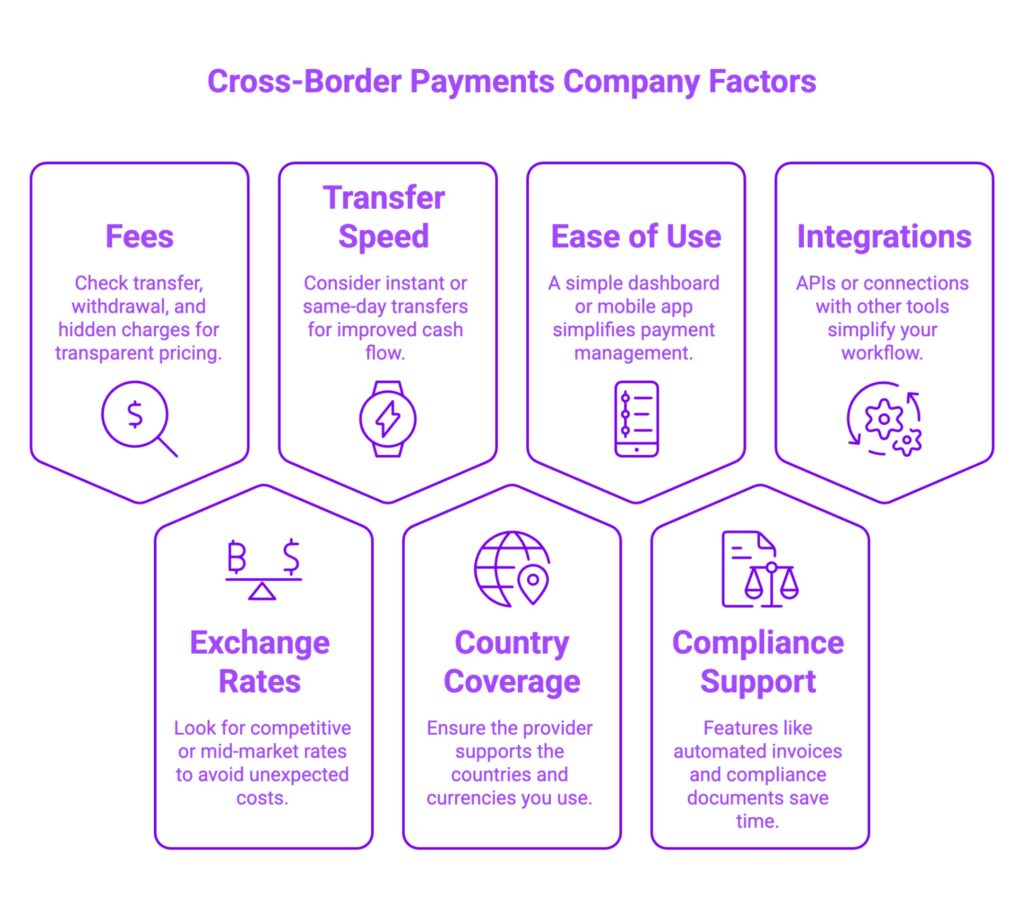
The right payment solution depends on your business model, transaction volume, and the countries you work with. Some platforms are built for freelancers and small businesses, while others are better suited for enterprises or global eCommerce brands.
Here are the key factors to consider before choosing one:
- Fees: Check the transfer fees, withdrawal fees, and any hidden charges. A provider with transparent pricing can help you avoid unexpected costs.
- Exchange rates: Even a small markup on currency conversion can add up over time. Look for providers that offer competitive or mid-market exchange rates.
- Transfer speed: Some platforms offer instant or same-day transfers, while others may take several business days. Faster settlements can improve cash flow.
- Country coverage: Make sure the provider supports the countries and currencies you send to or receive from most often.
- Ease of use: A simple dashboard or mobile app can make it easier to send payments, track transfers, and manage transactions.
- Compliance support: If you’re a business handling exports, payroll, or taxes, features like automated invoices and compliance documents can save time.
- Integrations: Some platforms offer APIs or connect with accounting, payroll, or eCommerce tools to simplify your workflow.
Want to keep more of your money on every transfer? Learn how to avoid hidden charges with our guide on how to avoid currency exchange fees.
What Challenges Can Businesses Face With Cross-Border Payments?
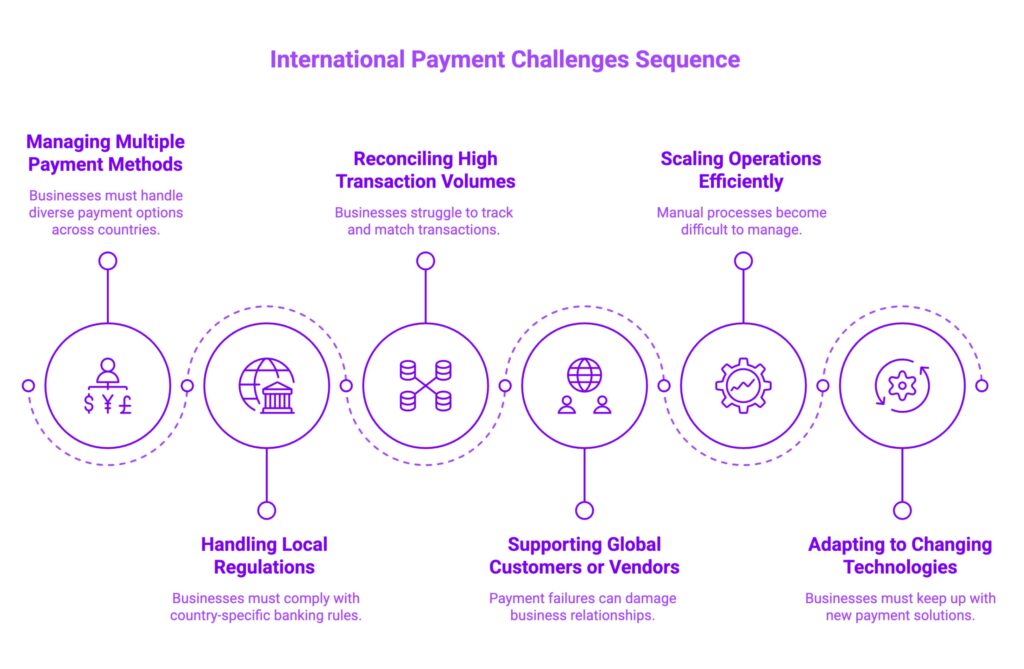
Even with the right provider, international payments come with challenges that go beyond just fees and transfer speed. As businesses scale globally, managing payments across multiple countries can become more complex and time-consuming.
Here are some common challenges to watch for:
- Managing multiple payment methods: Different countries prefer different payment options, from bank transfers to digital wallets and local payment methods.
- Handling local regulations: Every country has its own banking rules, reporting requirements, and documentation standards.
- Reconciling high transaction volumes: Businesses handling multiple international payments may struggle with tracking and matching transactions.
- Supporting global customers or vendors: Payment failures or delays can create poor experiences and affect business relationships.
- Scaling operations efficiently: As payment volume grows, manual processes can become difficult to manage without automation.
- Adapting to changing technologies: Businesses may need to keep up with new payment rails, real-time systems, or blockchain-based solutions.
Not sure whether to send now or wait? Read our forecast on whether the USD to INR exchange rate will increase.
What Is the Future of Cross-Border Payments?
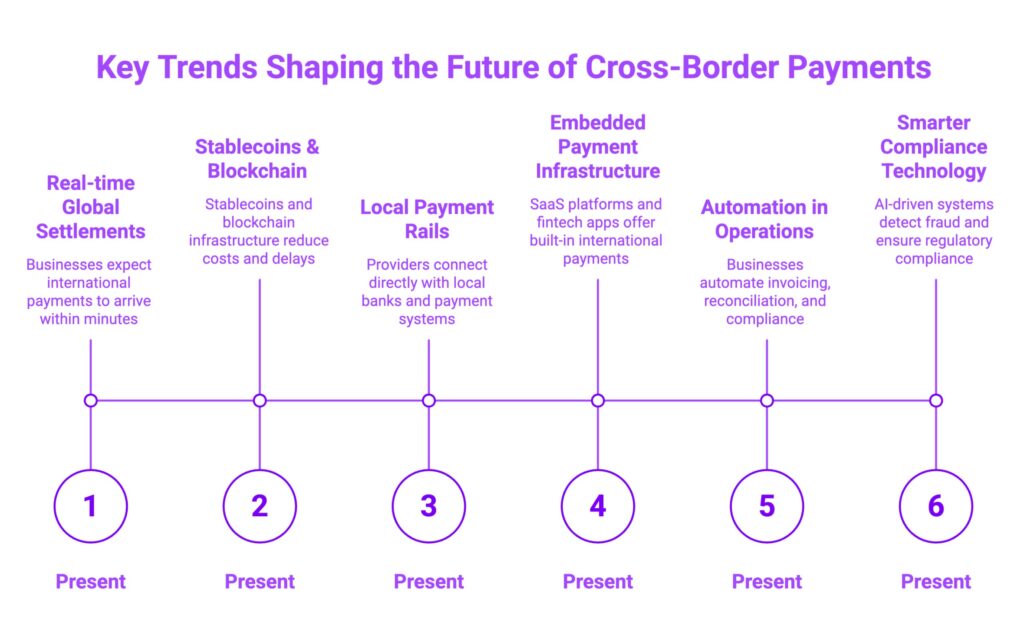
Cross-border payments are evolving quickly as businesses demand faster settlements, lower fees, and better global coverage. Traditional banking systems are slowly being replaced by technology-driven solutions that make international transactions more efficient and accessible.
Here’s what the future looks like:
- Real-time global settlements are becoming the standard: Businesses increasingly expect international payments to arrive within minutes instead of days, pushing providers to adopt faster payment rails.
- Stablecoins are reducing costs and delays: Platforms using stablecoins and blockchain infrastructure can bypass traditional intermediaries, making transfers faster and often cheaper.
- More local payment rails will improve reach: Providers are building direct connections with local banks and payment systems to improve speed and reduce dependency on SWIFT.
- Embedded payment infrastructure will grow: SaaS platforms, marketplaces, and fintech apps will increasingly offer built-in international payment capabilities.
- Automation will simplify operations: Businesses will rely more on automated invoicing, reconciliation, and compliance tools to manage global payments at scale.
- Compliance technology will become smarter: AI-driven systems will help detect fraud, verify identities, and ensure regulatory compliance in real time.
Final Thoughts
At the end of the day, international payments should be simple. You should not have to deal with delays, hidden charges, or confusing exchange rates just to move your money across borders.
The good news is that there are plenty of great options out there. Whether you’re a freelancer, a growing business, or a global brand, the right platform can save you time, reduce costs, and make international transactions much easier.
Take a look at what matters most to your business, compare your options, and choose a solution that helps you grow without the payment headaches.
Frequently Asked Questions
How do US-based cross-border payments companies compare to global providers?
US-based providers often focus on compliance requirements, AML, and KYC for domestic businesses, while global providers offer stronger global infrastructure, local currency support, and better cost efficiency for global operations across Europe, SEPA, and other global markets.
Who are the key players in cross-border payments?
Key players include Frex, Wise Business, Payoneer, Stripe, PayPal, Ripple, Airwallex, and banks with global networks. According to FXC Intelligence, these companies lead in global payment processing, remittances, electronic payments, and solutions for SMEs and large enterprises.
Which banks use XRP for cross-border payments?
Several banks and financial institutions have tested or used XRP for payment processing and liquidity management, including partners in Europe and Asia. Ripple’s global network helps reduce the lack of transparency and improves the entire process for cross-border remittances.
Why is “global coverage” a myth in cross-border payments?
“Global coverage” can be misleading because many providers lack true access to local currency rails, payment gateways, or banking partners in every region. Compliance requirements, KYC, AML rules, and limited infrastructure can restrict reach in global markets.
How do cross-border payments work?
Cross-border payments move money between countries through banks, payment gateways, or fintech platforms. The entire process includes payment processing, currency conversion, compliance checks, and settlement through local or global networks before funds reach business partners.
Can you explain the differences between cross-border payment platforms and solutions?
Cross-border payment platforms handle payment processing and transfers, while broader solutions include financial management tools, payment data tracking, compliance support, and cost efficiency features for finance teams managing global operations, remittances, or electronic payments at scale.




Leave a Reply