





Key Highlights
- USD to INR is trading near ₹90 to ₹91, close to historical highs for the dollar.
- A ₹1 move changes your payout by ₹10,000 on a $10,000 transfer.
- 2026 forecasts range roughly between ₹86 and ₹94 depending on Fed policy, oil prices, and global capital flows.
- The USD to INR outlook is influenced by factors such as US Federal Reserve policy, RBI intervention, crude oil prices, India’s trade balance, and global capital flows.
- The long-term trend shows gradual INR depreciation with periodic corrections.
- Instead of timing perfectly, use staggered transfers, track mid-market rates, and compare the final INR received.
- Frex offers zero transfer fees, competitive exchange rates, fast processing, and upfront INR visibility for USA to India transfers.
If you are planning to send money from the US to India, one question likely comes to mind first: will the USD INR exchange rate increase? Even a small movement in the USD to INR exchange rate can significantly impact how much your family receives. On a $10,000 transfer, a ₹1 change means a ₹10,000 difference in payout.
With the USD to INR exchange rate today reacting to US interest rates, inflation data, oil prices, and RBI policy decisions, timing your transfer feels crucial. Send too soon, and you may miss a stronger dollar. Wait too long, and today’s rate could disappear. For NRIs managing EMIs, investments, or family expenses in India, this uncertainty can be stressful.
In this guide, we analyze the US dollar USD to Indian rupee INR exchange rate history, current market drivers, and the latest USD to INR exchange rate forecast trends to help you decide whether to transfer now or wait.
USD to INR Exchange Rate Today: Where Do Things Stand?

As of early March 2026, the USD to INR exchange rate today is around ₹90.54 per USD at the official benchmark level, based on the RBI reference rate published by Financial Benchmarks India Pvt Ltd (FBIL). This places the rupee near historically weaker levels compared to previous years. For NRIs transferring funds from a US bank account to an Indian bank account, this means the dollar is currently relatively strong.
The official benchmark rate is published daily by Financial Benchmarks India Pvt Ltd (FBIL), which administers the RBI reference rate used as a standard indicator for currency markets in India.
However, it is important to distinguish between:
- Mid-market rate: Around ₹90.54 per USD, based on the latest RBI reference benchmark.
- Bank or transfer rate: Usually slightly lower because banks and transfer providers add exchange margins and fees.
- Intra-day volatility: The rate can move 20 to 50 paise within a single trading session.
- Recent trend: The rupee has gradually depreciated over the past year amid global dollar strength.
The current level reflects strong US interest rate positioning, global safe-haven demand for the dollar, oil price sensitivity, India’s external trade dynamics, and periodic RBI intervention.
For readers who want to track the movement visually, live USD to INR charts and historical trends are available on financial platforms such as Bloomberg and Moneycontrol.
Example: https://www.bloomberg.com/quote/USDINR:CUR
For NRIs, this is the baseline. The real decision now is whether these conditions suggest further upside for USD or a possible pullback before your next transfer.
Curious how taxes affect your remittance from the USA to India? Learn exactly how much tax you may pay on international transfers to optimize your total payout and avoid surprises.
What Does the US Dollar (USD) to Indian Rupee (INR) Exchange Rate History Tell Us?
Looking at the US dollar USD to Indian rupee INR exchange rate history helps put today’s levels into perspective. Over the past decade, the broader trend has been gradual rupee depreciation against the dollar, interrupted by short-term corrections. While there have been periods of stability, the long-term direction has largely favored a stronger USD.
Key historical milestones include:
- 2013–2014: INR crossed ₹60 per USD during the taper tantrum phase.
- 2018–2019: The pair moved into the ₹70–₹74 range amid oil price volatility.
- 2020 (pandemic period): USD strengthened sharply as global markets sought safety.
- 2022–2024: The pair crossed ₹80 and then ₹85 as US rate hikes accelerated.
- 2025–2026: USD trading near the ₹90+ zone amid persistent dollar strength.
Historically, major USD surges have been linked to:
- US Federal Reserve tightening cycles
- Global financial uncertainty
- Rising crude oil prices
- Capital outflows from emerging markets
For NRIs, the historical pattern shows one important lesson: while short-term corrections do happen, long-term depreciation of INR has been gradual rather than sudden. This makes timing important, but it also highlights that waiting indefinitely for a sharp rupee recovery has rarely worked over multi-year horizons.
What Factors Could Push USD Higher Against INR This Year?
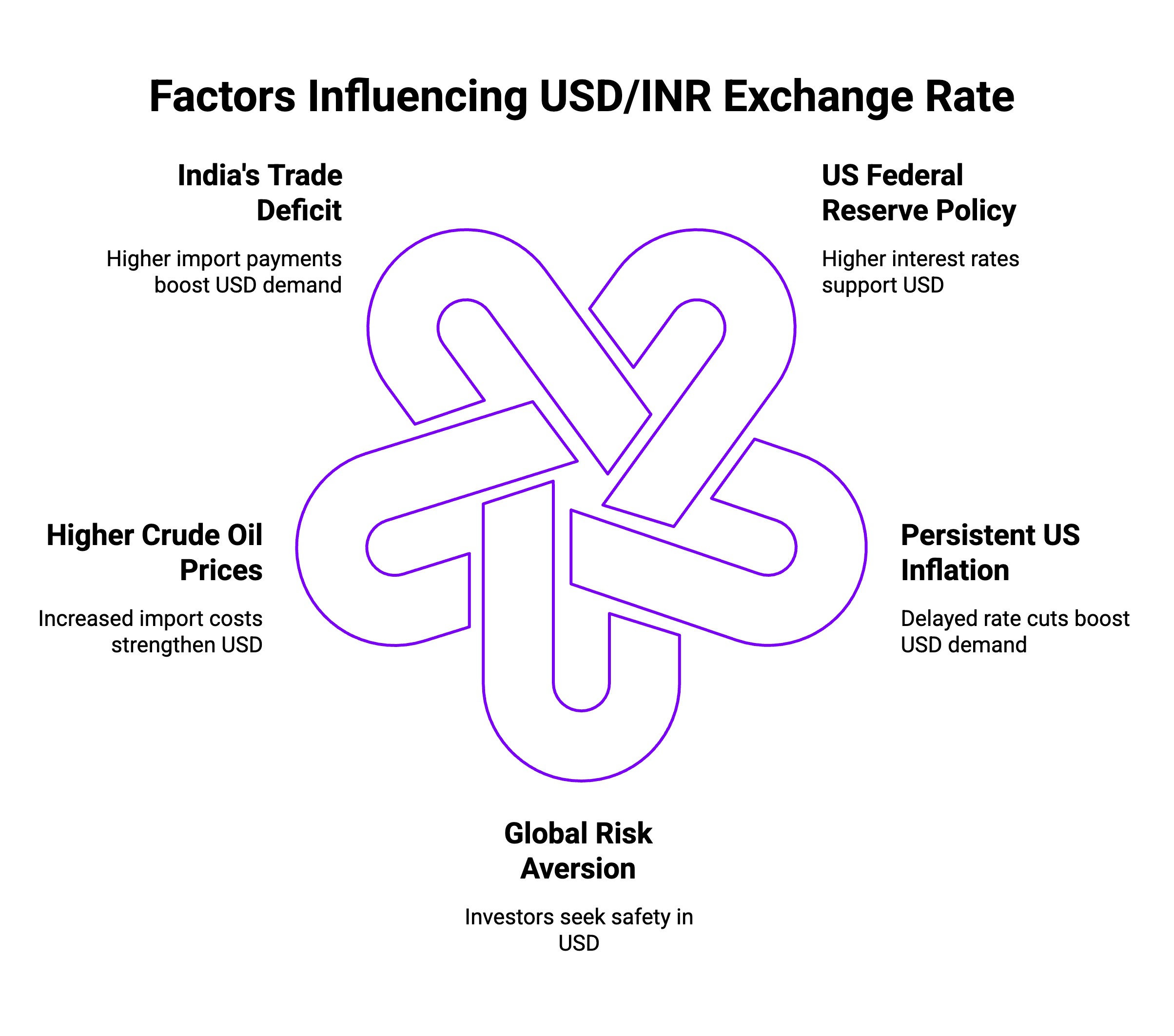
The key question is whether current conditions support further dollar strength. Any realistic USD to INR exchange rate prediction depends on how interest rates, inflation, and global capital flows evolve in the coming months.
Here are the main forces that could support a stronger USD:
- US Federal Reserve policy: If rates remain elevated for longer, the dollar typically stays strong.
- Persistent US inflation: Delayed rate cuts tend to support USD demand.
- Global risk aversion: During uncertainty, investors move toward the US dollar.
- Higher crude oil prices: Since India imports most of its oil, rising prices increase dollar demand and can weaken INR.
- India’s trade deficit / current account deficit: When India imports more than it exports, more dollars are needed to pay for those imports. A widening deficit can increase USD demand and put downward pressure on the rupee.
At the same time, the rupee could stabilize or strengthen if:
- The Fed begins cutting rates sooner than expected
- India attracts sustained foreign investment inflows
- RBI intervenes to smooth volatility
- Oil prices ease meaningfully
Current USD to INR exchange rate forecast outlooks suggest controlled volatility rather than runaway moves. For NRIs planning a US to India transfer, this means potential upside may exist, but dramatic spikes are less predictable than steady trends.
Planning your remittance from the USA to India? Check out our NRI guide to smart sending tips, cost breakdowns, and common pitfalls to avoid before you transfer.
What Are Experts Saying in the USD to INR Exchange Rate Forecast?
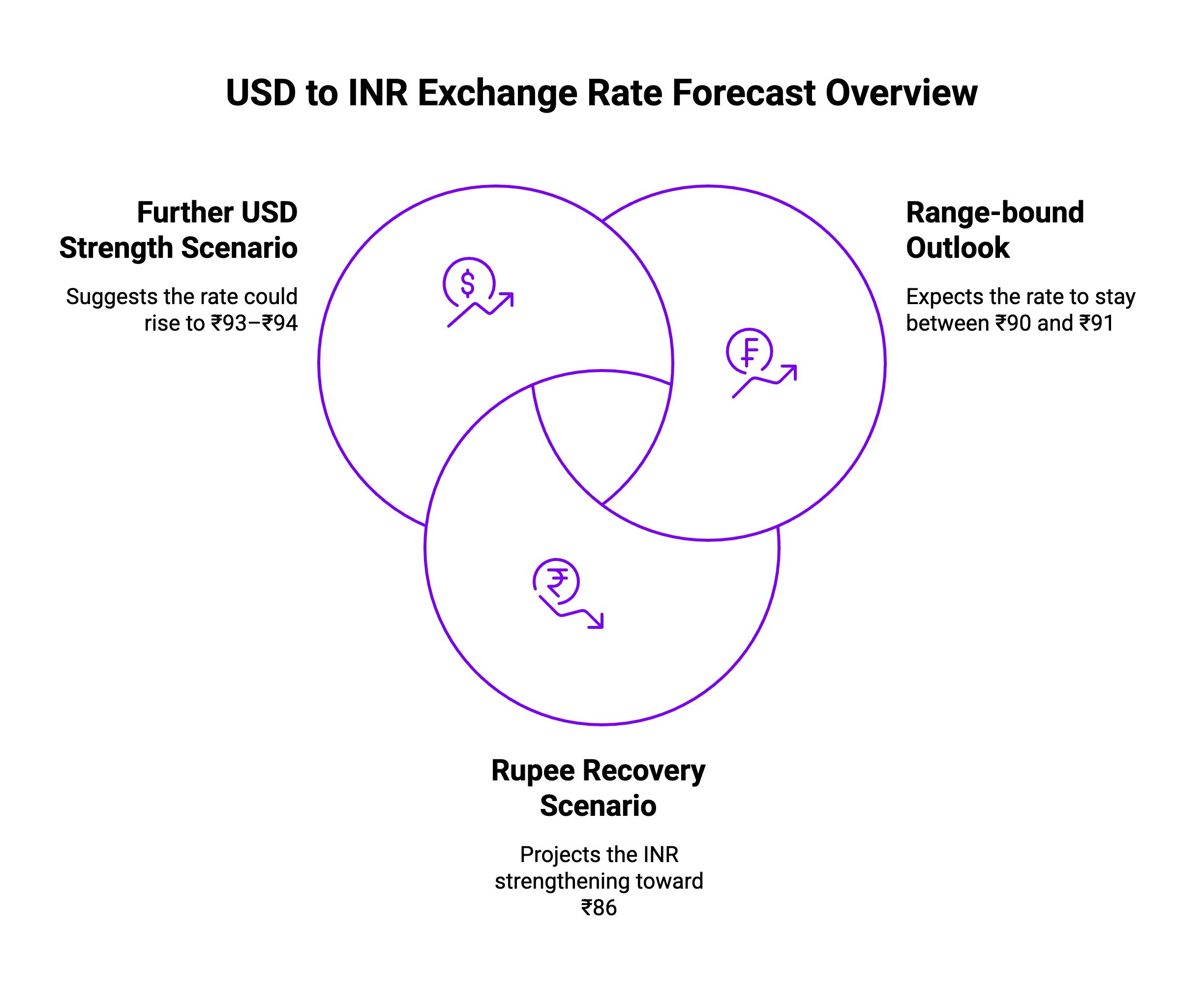
The current USD to INR exchange rate forecast shows a split view among major global institutions. While no one can predict exact levels, leading banks and FX strategists have outlined clear directional scenarios for 2026. The overall consensus suggests controlled volatility rather than extreme currency swings.
Here is how expert projections are shaping up:
- Range-bound outlook (₹90–₹91): A Reuters poll of 27 FX strategists expects USD/INR to remain broadly near current levels through 2026, indicating limited dramatic upside in the base-case scenario.
- Rupee recovery scenario (toward ₹86): Bank of America Global Research has projected potential INR strengthening toward ₹86 per USD by end-2026, suggesting that recent weakness is largely driven by global dollar strength rather than structural Indian fundamentals.
- Further USD strength scenario (₹93–₹94)
Reports cited by The Economic Times, referencing institutions such as UBS, indicate downside risks for INR that could push the pair toward ₹93–₹94 if US rate cuts are delayed and foreign capital flows weaken.
For NRIs planning transfers from a US bank account to an Indian bank account, these projections highlight an important takeaway.
The current USD-to-INR exchange rate prediction band for 2026 spans roughly ₹86 to ₹94. That is a meaningful range. Instead of waiting for a perfect peak, it is often smarter to base transfer decisions on urgency, transfer size, and risk tolerance.
Exchange Rate Comparison USD to INR: Then vs Now
To understand whether you should wait, it helps to look at an exchange rate comparison of USD to INR across recent years. The shift over time shows how gradually the rupee has depreciated against the dollar.
Here’s how the levels have evolved:
- 2020: Around ₹74–₹76 per USD
- 2022: Crossed ₹80 per USD (~6–8% depreciation from 2020)
- 2023–2024: Moved into the ₹83–₹85 range (~12–14% depreciation from 2020)
- 2025–2026: Trading near ₹90–₹91 per USD (~21–22% depreciation from 2020)
Now let’s look at what that means in practical remittance terms:
- $5,000 transfer at ₹75 → ₹3,75,000
- $5,000 transfer at ₹85 → ₹4,25,000
- $5,000 transfer at ₹91 → ₹4,55,000
That is an ₹80,000 difference between 2020 levels and today for the same $5,000 transfer — purely due to exchange rate movement.
Should NRIs Wait or Transfer Now?
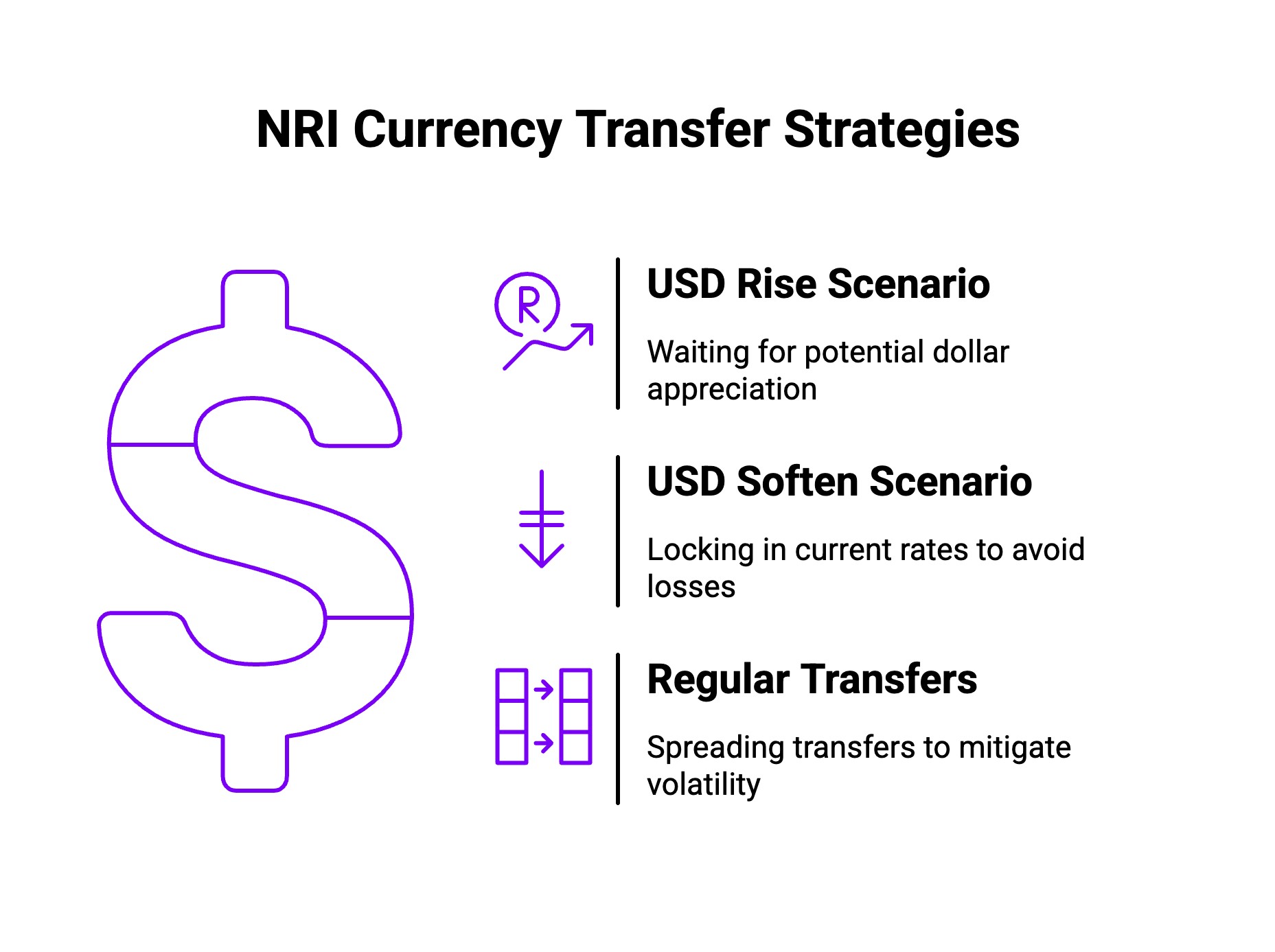
After reviewing the current USD to INR exchange rate today and expert forecast ranges, the real decision comes down to timing strategy. There is no guaranteed way to perfectly predict short-term currency moves. Instead, the smarter approach is scenario-based decision-making.
Here are three practical ways NRIs can think about it:
- If you believe USD may rise further: Waiting could increase your payout if the dollar strengthens toward the upper forecast range. However, this comes with risk. If the Fed signals rate cuts sooner than expected or global sentiment improves, the rupee could strengthen and reduce your conversion value.
- If you believe USD may soften: Locking in the current rate protects you from downside risk. With the pair already near elevated levels historically, some forecasts suggest limited dramatic upside under normal conditions.
- If you transfer regularly: Instead of trying to time the peak, consider splitting transfers across weeks or months. This reduces exposure to short-term volatility and smooths out rate fluctuations.
For NRIs transferring from a US bank account to an Indian bank account, the key insight is this: exchange rates move in ranges, not straight lines. The goal is not to guess perfectly. It is to manage risk while aligning transfers with your financial needs in India.
Wondering about the tax impact on your remittance? Understand transfer money from USA to India tax implications so you keep more of what you send and avoid costly surprises.
How Can NRIs Maximize Their USD to INR Transfer Value?
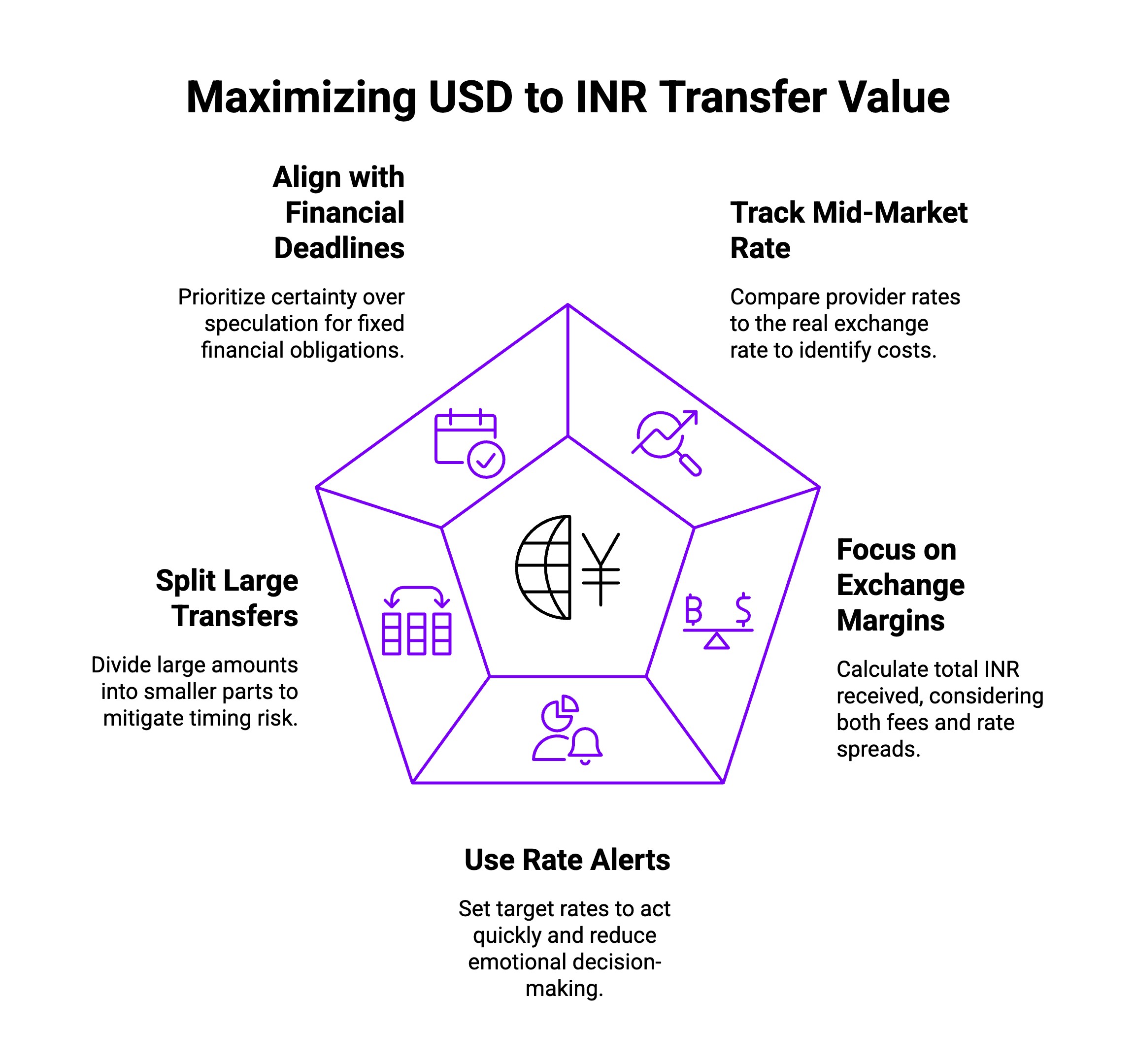
Understanding the USD to INR exchange rate forecast is only half the strategy. The actual amount credited to your Indian bank account depends heavily on how and when you execute the transfer. Small structural advantages can meaningfully increase your final payout.
1. Track the Mid-Market Rate Before Transferring
The mid-market rate is the real exchange rate at which banks trade currencies among themselves. It acts as the benchmark. Before initiating a transfer, check this rate and compare it to the rate your bank or provider is offering.
If the provider’s rate is significantly lower, that difference is effectively your cost. Even a 0.5 to 1 rupee gap per dollar can reduce your payout substantially on larger transfers.
2. Focus on Exchange Margins, Not Just Transfer Fees
Many providers advertise low or zero transfer fees, but compensate by building profit into the exchange rate. For example, if the mid-market rate is ₹91 and you are offered ₹89.8, that spread can cost more than a visible service fee. Always calculate the total INR you will receive rather than focusing only on upfront charges.
Download the Frex iOS app to see the real exchange rate and exact INR you’ll receive before sending money to India.
3. Use Rate Alerts to Avoid Guesswork
Instead of constantly checking the USD to INR exchange rate today, set a target rate that aligns with your expectations. Rate alerts help you act quickly when the market reaches your desired level. This reduces emotional decision-making and improves discipline in timing.
4. Consider Splitting Large Transfers
If you are sending a large amount such as $15,000 or $20,000, splitting it into smaller parts over a few weeks can reduce timing risk. This approach, similar to dollar-cost averaging, helps smooth out short-term fluctuations and protects you from transferring the entire amount at a temporary peak or dip.
5. Align Transfers With Your Financial Deadlines
If you have fixed obligations in India such as EMIs, tuition payments, or investment commitments, prioritize certainty over speculation.
Waiting for a slightly better rate may not be worth the stress if you have a defined timeline. In such cases, securing a competitive rate within the current range may be more practical than chasing marginal gains.
For NRIs transferring funds from a US bank account to an Indian bank account, optimizing execution often produces more consistent results than trying to perfectly predict whether the dollar will rise further.
Looking to keep every dollar working for you? Discover how to send money from the USA to India without charges and minimize transfer costs.
What Key Factors Could Change the USD to INR Outlook?
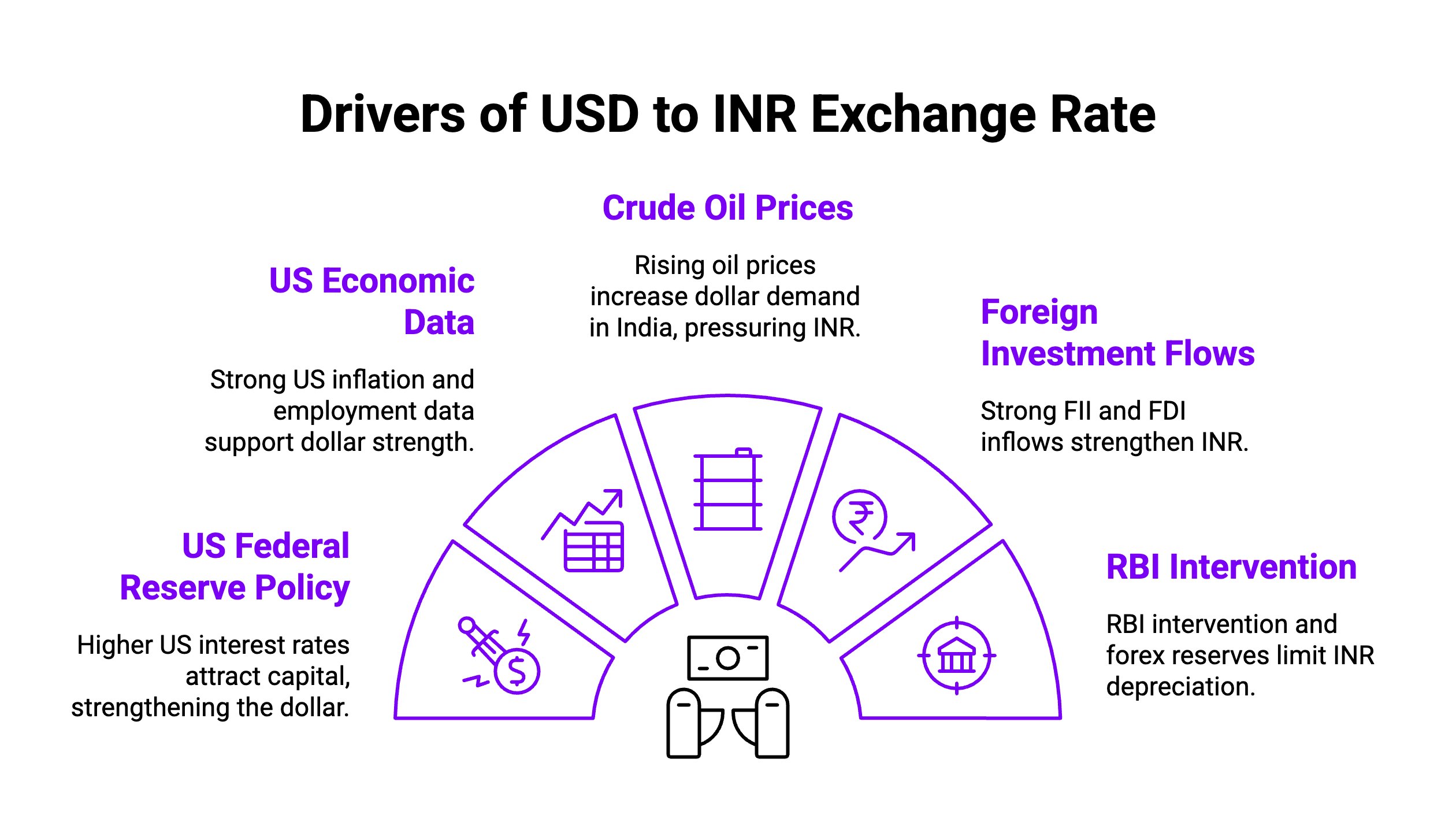
The direction of the USD-to-INR exchange rate is driven by macroeconomic forces rather than daily noise. If you are deciding whether to transfer now or wait, monitoring these structural drivers is more useful than reacting to small intraday movements. Currency trends typically shift when monetary policy, capital flows, or global risk sentiment change meaningfully.
The most important factors to watch include:
- US Federal Reserve interest rate policy: Higher US rates generally strengthen the dollar by attracting global capital into US assets. Delayed rate cuts can keep USD elevated.
- US inflation and economic data: Strong inflation or employment data may support dollar strength. Softer data can increase expectations of rate cuts and weaken the USD.
- Crude oil prices: Since India is a major oil importer, rising crude prices increase dollar demand in India and can pressure INR. Lower oil prices tend to support rupee stability.
- Foreign investment flows into India: Strong FII and FDI inflows can strengthen INR. Sustained outflows often weaken it.
- RBI intervention and forex reserves: The Reserve Bank of India can step in to reduce excessive volatility. Large forex reserves help limit sharp depreciation.
For NRIs transferring funds from a US bank account to an Indian bank account, tracking these indicators provides clearer signals than short-term market reactions. Structural shifts in these variables often determine whether the dollar continues rising or stabilizes.
What Is the Best Time to Transfer Money From USA to India?
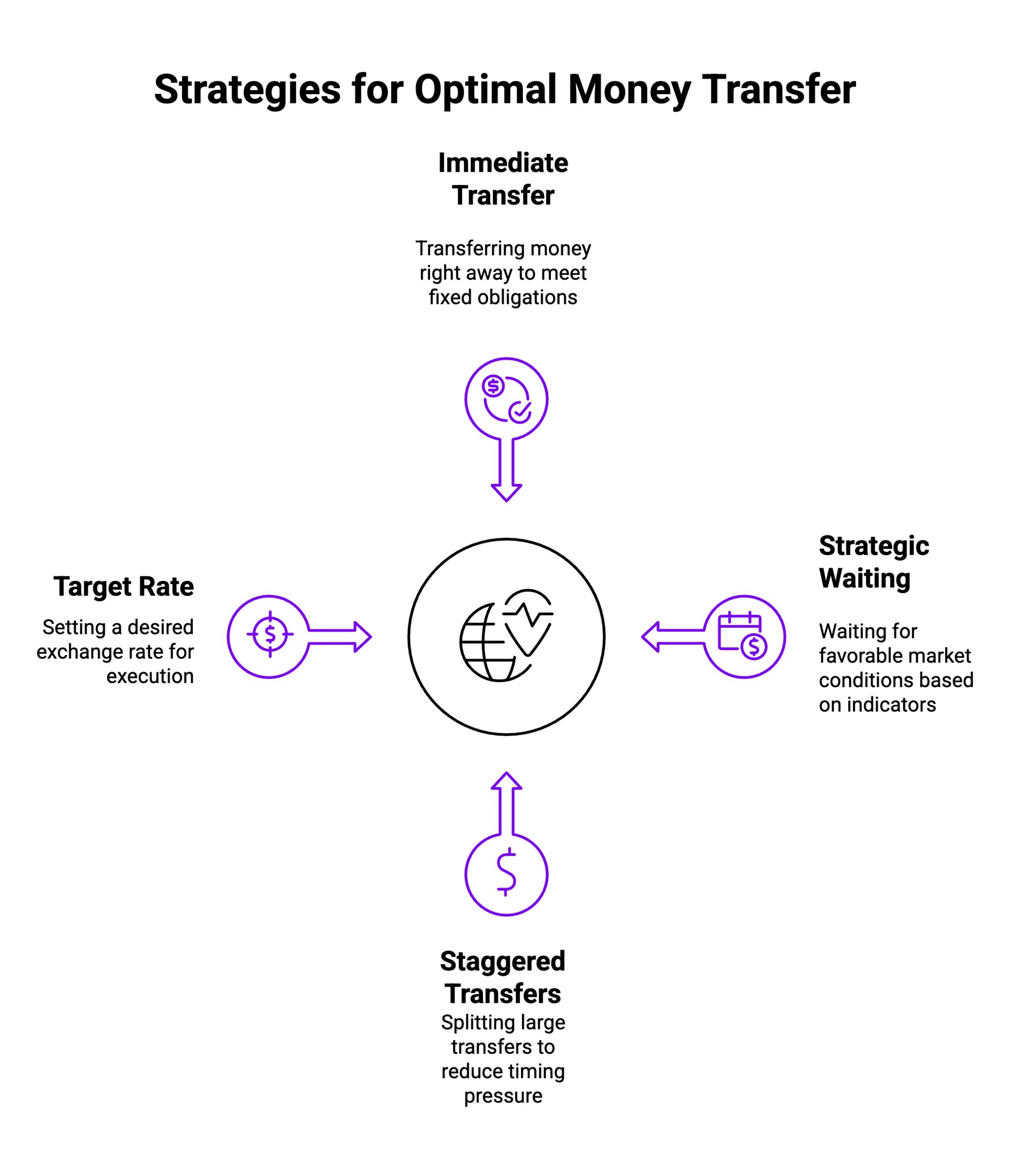
Instead of asking only whether the dollar will rise, the better question is when a transfer makes financial sense for you.
Here is a practical framework NRIs can use:
- Transfer immediately: If you have fixed obligations such as EMIs, tuition fees, property payments, or family expenses, certainty matters more than speculation. Locking a competitive rate now removes risk.
- Wait strategically: If your transfer is flexible and macro indicators suggest short-term dollar strength, waiting may provide incremental upside. However, this should be based on clear triggers such as upcoming Fed meetings or inflation data, not guesswork.
- Use staggered transfers: For larger amounts, splitting the transfer reduces timing pressure. This balances opportunity and risk without relying on a single rate entry point.
- Set a target rate: Decide in advance what rate makes the transfer worthwhile for you. When the market reaches it, execute without hesitation.
For NRIs transferring from a US bank account to an Indian bank account, the goal is not to predict every move in the USD-to-INR exchange rate. The goal is to combine timing discipline with cost efficiency so your transfer aligns with your financial objectives in India.
Curious why some remittances cost more than others? Learn about the charges for sending money from the USA to India so you can plan transfers more smartly.
How Much Does a ₹0.50 Move Actually Impact Your Transfer?
Instead of focusing only on direction, it helps to quantify impact. Small exchange rate movements feel abstract until you translate them into real rupee differences.
Here’s what common rate shifts mean in practice:
| USD Transfer Amount | Impact of ₹0.50 Move | Impact of ₹1 Move |
|---|---|---|
| $5,000 | ₹2,500 difference | ₹5,000 difference |
| $10,000 | ₹5,000 difference | ₹10,000 difference |
| $20,000 | ₹10,000 difference | ₹20,000 difference |
This shows why even small fluctuations in the USD-to-INR exchange rate matter more for larger transfers. At the same time, it highlights an important reality: provider spreads of ₹0.40 to ₹0.80 can quietly offset the gains you are waiting for in the market.
Why Choose Frex for Your USD-to-INR Transfers?
When you are sending money from a US bank account to an Indian bank account, the timing of the USD-to-INR exchange rate is only part of the equation.
The platform you choose directly impacts how much INR your recipient receives. At Frex, we are focused on helping NRIs maximize value through cost efficiency, speed, and transparency.
Here’s what we offer:
- Zero transfer fees: We do not charge upfront transaction fees that reduce your transfer value.
- Competitive exchange rates: We provide strong, transparent rates designed to help you maximize INR payout per dollar sent.
- Fast processing: We complete transfers quickly, minimizing delays and reducing exposure to rate fluctuations.
- Upfront clarity: We show you the exact exchange rate and the final INR amount before you confirm, so you know exactly what your recipient will receive.
- No minimum transfer requirement: Send money based on your needs without worrying about minimum transaction limits.
- Compliance and security: Frex follows strict regulatory standards and security protocols to help ensure safe, reliable international transfers.
If you are tracking the USD-to-INR exchange rate today, combining smart timing with a cost-efficient platform like Frex helps you keep more of every dollar you send.
Final Words
Will the USD INR exchange rate increase? Possibly. But waiting for the perfect peak is rarely a reliable strategy.
What matters more is understanding the range, knowing how much small movements impact your transfer, and minimizing hidden costs. A ₹1 move helps, but so does avoiding poor exchange spreads.
If you are sending money from a US bank account to an Indian bank account, focus on smart timing, realistic expectations, and cost-efficient execution. Currency markets move. Your goal is to move with them, not chase them.
Frequently Asked Questions
Are there recent news events affecting the USD to INR rate trend?
Recent strong US dollar momentum has been supported by delayed Fed rate cuts and persistent high crude prices, pressuring the INR currency pair. Foreign investors’ flows and India’s trade deficit also influence INR forecast trends in the forex market.
Where can I find reliable daily updates on the USD to INR exchange rate?
You can use a live currency converter or app with up-to-date price predictions and technical analysis (e.g., relative strength index and ema) to monitor the INR pair daily for money transfer and investment advice.
What is the future prediction of USD to INR?
Most forecasts suggest USD/INR will remain volatile but broadly range-bound, influenced by US interest rate decisions, inflation trends, oil prices, and foreign capital flows. Analysts expect gradual movements rather than extreme spikes unless triggered by unexpected global or domestic economic shocks.
Is it a good time to exchange USD to INR?
It depends on your financial goals and urgency. Current levels are relatively elevated compared to past years, but short-term fluctuations are common. If you have fixed obligations in India, securing a competitive rate now may reduce uncertainty and timing risk.
Will the USD rate keep increasing against INR?
The dollar could remain strong if US interest rates stay higher for longer and global investors favor US assets. However, sustained sharp appreciation is uncommon without major macroeconomic shifts, and periodic corrections are normal in currency markets.
Which factors will drive the USD to INR in 2026?
Key drivers will include Federal Reserve policy decisions, RBI actions, crude oil prices, India’s trade balance, inflation data, and foreign investment flows. Global risk sentiment and geopolitical developments may also influence currency direction throughout the year.
What will happen if the Indian rupee value overtakes the US dollar?
Such a reversal is extremely unlikely under current global conditions. It would require major structural changes in economic strength, global trade dominance, and reserve currency status, which typically evolve over decades rather than short time periods.




Leave a Reply