





Key Highlights
- ACH is a US domestic payment network and cannot be used to send money directly from the USA to Indian bank accounts.
- ACH is commonly used to fund international transfers through online remittance apps that handle cross-border payments.
- ACH-funded transfers usually take two to five business days, depending on bank processing and verification checks.
- Fees are generally lower than traditional wire transfers, with exchange rates playing a major role in total cost.
- ACH transfers have daily or monthly limits that vary by bank, provider, and verification status.
- Compliance checks, KYC requirements, and bank holidays can affect transfer timelines.
- Tax considerations may apply, including US gift tax limits and Indian FIRC documentation for recipients.
Sending money from the USA to India often feels more complicated than it should. You search for simple bank transfer options, come across ACH, and assume it might be the easiest and cheapest way to move money internationally. But once you start looking closer, the answers feel unclear and sometimes contradictory.
The reason for this is how ACH actually works. While it is widely used for everyday payments within the US, it is designed only for domestic transfers and does not operate as an international payment system. This distinction is what creates uncertainty around whether ACH can be used for India and how it compares to other transfer methods.
This blog breaks it all down in a clear and practical way. You will learn whether ACH can be used to send money to India, how ACH-funded transfers really work, what costs and timelines to expect, and when this method makes sense compared to other options.
What Is An ACH Transfer?
An ACH transfer is an electronic bank-to-bank payment used within the United States, processed through the Automated Clearing House network. It is commonly used for everyday transactions like direct deposits, bill payments, and transferring money between US bank accounts. These transfers are typically low-cost and processed in batches, which is why they may take one to three business days to complete.
Can You Do An ACH Transfer From the USA To India?
ACH is a payment network designed specifically for domestic bank transfers within the United States. It is used to move money between US bank accounts for things like payroll, bill payments, and direct debits. Because it operates only within the US banking system, it does not support direct international transfers. That is why the answer is no, you cannot send money straight from a US bank account to an Indian bank account using ACH alone.
Many people assume ACH works globally because it is often used to fund international money transfers through apps and online platforms. This creates the impression that an ACH payment from the US to India is happening directly, when in reality, ACH is only used on the US side to move funds locally. The international leg of the transfer is completed through other payment systems designed for cross-border transactions.
Step-By-Step: How Does An ACH-Funded Transfer To India Typically Work?

When sending money from the USA to India using ACH as a funding method, ACH is used only to move funds within the US banking system. A third-party provider, such as a money transfer service, remittance platform, or financial institution, then manages the international part of the transfer using its own banking and payment networks. From the sender’s perspective, the process feels simple because these steps are handled in the background. Here are the key stages involved in an ACH-funded transfer to India.
1. Authorizing An ACH Debit From A US Bank
The process starts when you link your US bank account with a transfer service and authorize an ACH debit. This allows the provider to withdraw funds from your bank within the United States. At this stage, the transaction remains fully domestic and no international movement has occurred.
2. Funds Reaching The Provider’s US Bank Account
Once the ACH debit is processed, the funds move from your bank to the provider’s bank account in the US. This step happens entirely within the US banking system and usually takes one to three business days, depending on bank processing schedules and cut-off times.
3. Currency Conversion From USD To INR
After the funds are settled in the provider’s US bank account, the amount is converted from US dollars to Indian rupees. This conversion is handled by the provider using its own exchange mechanisms and rates, separate from the ACH network. The rate applied directly affects how much INR the recipient receives.
4. Final Credit To An Indian Bank Account
Once the conversion is complete, the provider initiates an international transfer through its partner banking and payment networks. The funds are then credited locally to the recipient’s Indian bank account in INR, often on the same day or the next business day, depending on processing timelines and bank availability.
Overall, ACH functions only as the initial funding step within the US, while the provider manages the international transfer and final delivery to India. This structure allows ACH-funded transfers to work without relying on direct international ACH transactions.
How Long Does An ACH-Based Transfer To India Take?
An ACH-based transfer to India usually takes a few business days to complete from start to finish. The first part involves the ACH debit from your US bank account, which typically takes one to three business days to clear. This timeline depends on your bank’s processing cycles and whether the transfer is initiated on a business day.
Once the funds reach the remittance provider, the international transfer and INR credit to the Indian bank account often happen quickly, sometimes within the same day or the next business day. In most cases, the total transfer time ranges from two to five business days, assuming there are no verification checks or bank holidays causing delays.
What Are The Factors That Can Delay ACH Transfers?
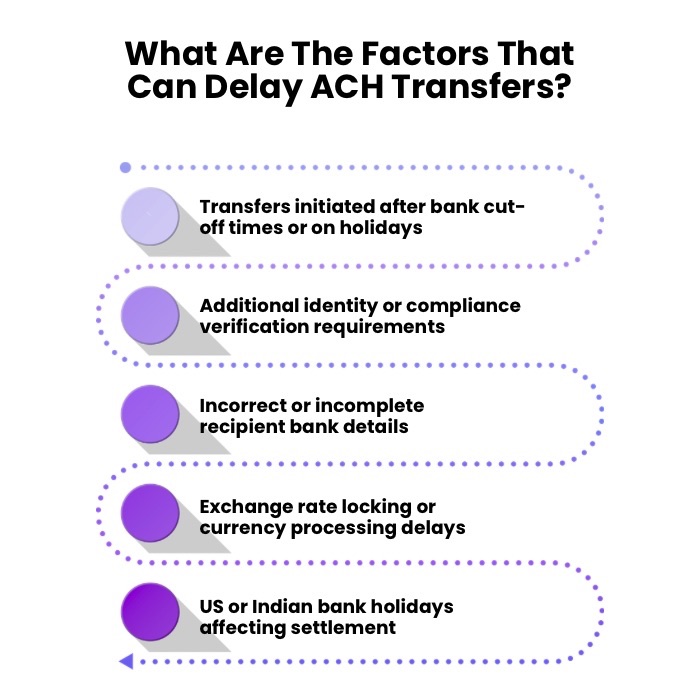
Even though ACH-funded transfers are generally reliable, delays can still happen at different stages of the process. These slowdowns are usually linked to banking timelines, verification checks, or external factors beyond your control. Here are the most common reasons an ACH-based transfer to India may take longer than expected.
1. Bank Processing Timelines
ACH transfers are processed in batches rather than in real time. If a transfer is initiated after cut-off hours, on weekends, or on US bank holidays, the processing can be pushed to the next business day.
2. Verification And Compliance Checks
Remittance providers are required to complete identity and compliance checks before releasing funds. If additional verification is needed, such as confirming account details or transaction purpose, this can temporarily delay the transfer.
3. Incorrect Or Incomplete Bank Details
Errors in the recipient’s bank account information can stop the transfer from moving forward. Even small mistakes may require manual review and correction before the funds can be credited.
4. Exchange Rate Locking And Currency Processing
Some providers wait for the exchange rate to be locked before completing the conversion from USD to INR. This can add time, especially during periods of high currency volatility.
5. Bank Holidays In The US Or India
Public holidays in either country can affect processing times. While ACH is impacted by US banking holidays, the final credit can also be delayed if Indian banks are closed.
In most cases, these delays are temporary and avoidable with accurate details and timely initiation, making ACH-funded transfers a dependable option when planned around banking schedules.
Looking for a simpler way to send money? Read our guide on how to send money to India from the USA without hassleto explore easy, stress-free options.
How Is An ACH Transfer Different From The Traditional Wire Transfer?
When sending money from the USA to India, ACH-funded transfers and traditional wire transfers can feel similar at first glance, but they work very differently behind the scenes. Understanding these differences can help you choose the option that fits your priorities, whether that is lower cost, faster delivery, or ease of use.
The table below breaks down how both methods compare across key factors.
| Feature | ACH-Funded Transfer | Traditional Wire Transfer |
|---|---|---|
| Speed | Takes a few business days due to ACH processing and international settlement. | Usually reaches the recipient within three to five business days. |
| Fees | Generally lower, especially when using online remittance apps. | Higher fees charged by US banks, often with additional receiving bank charges. |
| Exchange Rates | Often closer to market rates, depending on the provider. | Banks typically apply a higher markup on exchange rates. |
| Ease Of Setup | Simple digital setup by linking a US bank account. | Requires detailed bank information and manual setup through a bank. |
| Best Use Cases | Ideal for regular transfers, smaller to mid-sized amounts, and cost-conscious users. | Better suited for large, one-time transfers or bank-to-bank transactions. |
ACH-funded transfers make sense when you value lower costs and convenience, while traditional wire transfers are more suitable when speed or direct bank handling is the top priority.
What Are The Limits And Restrictions On ACH Transfers From The USA To India?
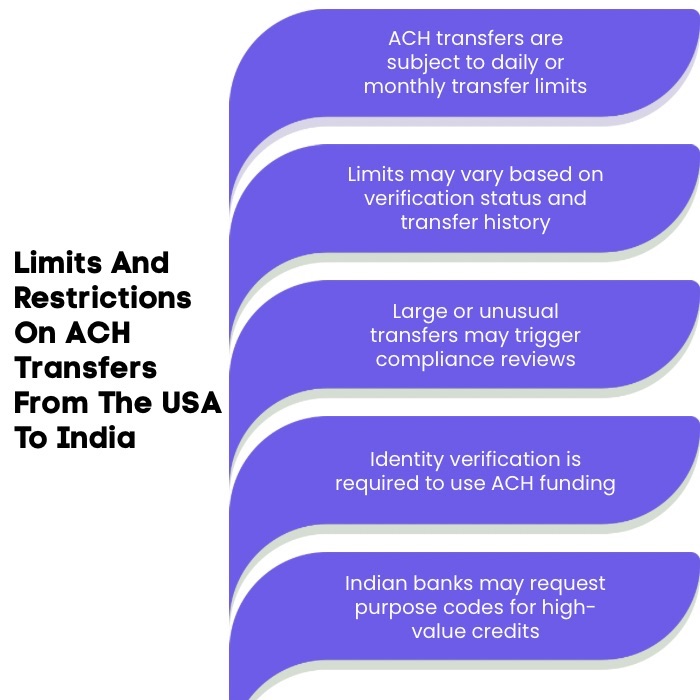
ACH-funded transfers are subject to specific limits and regulatory checks on both the US and Indian sides. These controls are in place to ensure secure transactions and compliance with financial regulations, and they can affect how much and how often you are able to send money from the US to India.
- Transfer Limits and Caps: Most banks and remittance providers apply daily or monthly limits on ACH-funded transfers. These caps often depend on your verification status, transaction history, and whether the transfer is set up as recurring or one-time.
- Bank and Provider Policies: Each provider sets its own risk thresholds for ACH debits. New users may start with lower limits, which can increase over time as the account builds a reliable transfer history.
- Compliance and Monitoring Checks: ACH transfers are monitored for fraud and regulatory compliance. Larger amounts or unusual transfer patterns may trigger additional reviews before the funds are released.
- KYC Requirements in the US: To use ACH, senders are usually required to complete identity verification. This helps confirm account ownership and ensures the transfer complies with US banking regulations.
- Incoming Remittance Rules in India: Indian banks may apply their own checks for foreign inward remittances. In some cases, recipients may need to provide purpose codes or supporting information for higher-value transfers.
Overall, these limits and requirements are standard safeguards rather than obstacles, and understanding them in advance can help you plan ACH-funded transfers to India more smoothly.
Wondering how much you can send in one go? Read what is the maximum limit for money transfer from USA to India to understand transfer caps and restrictions.
What Are The Tax And Compliance Considerations When Sending Money To India?
When sending money from the USA to India, it is important to understand the basic tax and compliance rules that apply to cross-border transfers. From the US side, most personal remittances fall under gift tax guidelines. In many cases, you can send money to family members without immediate tax implications, as long as the amount stays within the IRS annual gift tax exemption, which is currently set at $19,000 per recipient per year.
On the Indian side, banks issue a Foreign Inward Remittance Certificate, commonly known as an FIRC, for incoming international transfers. This document may be required by the recipient for tax filings, investments, or regulatory reporting. Proof of remittance can also be requested for larger transactions, property purchases, or business-related payments, which is why keeping records is especially important when using an ACH money transfer to India.
Want to avoid tax confusion when sending money abroad? Check out our guide on How to Transfer Money from USA to India Without Tax to understand the rules and stay compliant.
Why Frex Makes Sending Money From The USA To India Simpler
If the idea of using ACH to send money to India feels confusing, Frex is built to remove that friction. Frex uses ACH-based US bank debits to let you fund international transfers easily, without asking you to deal with wire transfers, bank visits, or complicated setup. You simply link your US bank account, authorize the ACH debit, and Frex handles the rest.
What makes Frex stand out is how smoothly that ACH-funded transfer turns into a fast INR credit in India. You get competitive exchange rates, clear pricing with no hidden fees, and quick delivery to Indian bank accounts. For anyone looking to send money regularly or avoid the high costs and delays of traditional wires, Frex offers a straightforward, reliable way to move money from the USA to India with confidence.
Download the Frex app today and send money from the USA to India with simple steps, clear pricing, and full transparency.
Conclusion
ACH cannot be used to send money directly from the USA to India, but it plays an important role in making international transfers simpler and more affordable. When used through a trusted remittance app, ACH allows you to fund transfers easily from your US bank without the high fees often associated with traditional wire transfers.
By understanding how ACH-funded transfers work, along with their timelines, limits, and compliance requirements, you can make informed decisions and choose a method that balances cost, convenience, and reliability when sending money to India.
Frequently Asked Questions
How can I make an ACH transfer from the USA to India?
You can make an ACH-funded transfer by linking your US bank account to a money transfer app or remittance provider. The app uses ACH to debit your bank account, then sends the funds to India using international payment networks.
Which Indian banks accept ACH transfers from the USA?
Indian banks do not directly accept ACH transfers because ACH is a US domestic system. Instead, the remittance provider credits funds to Indian banks after completing the international transfer, effectively acting as an ACH transfer that accepts Indian banks through its network.
Are there any security risks with ACH transfers from the US to India?
ACH-funded transfers are generally secure when processed through regulated banks and licensed remittance providers. Risks mainly arise from incorrect bank details or using unverified platforms, which is why choosing a compliant provider and enabling account security features is important.
Are there any fees involved in making an ACH transfer from the US to India?
Fees can include a small ACH processing charge, a transfer fee from the remittance provider, and exchange rate markup. Compared to bank wire transfers, these costs are often lower, especially when using apps that offer transparent pricing.
What are the daily or monthly limits for ACH transfers from the USA to India?
Limits vary by bank and remittance provider. Daily or monthly caps depend on your verification level, transaction history, and risk checks. New users often start with lower limits that can increase over time.
Is an ACH transfer better than SWIFT for sending money to India from the USA?
ACH-funded transfers are usually better for cost and convenience, while SWIFT wire transfers may suit large or urgent transactions. ACH-based options are often easier to set up and cheaper, whereas SWIFT offers direct bank-to-bank handling.
Which is faster, ACH or RTGS?
RTGS is faster because it processes transfers in real time within India. ACH is slower since it runs in batches and only covers the US side, with international processing added before funds reach an Indian bank.




Leave a Reply