





Key Highlights
- Both NRE and NRO accounts are maintained in Indian rupees, but differ in fund source eligibility.
- NRE vs. NRO accounts differ based on source of income, tax treatment, and repatriation flexibility.
- NRE accounts are ideal for foreign earnings, offering tax-free interest and full repatriation.
- NRO accounts are mandatory for managing Indian income, such as rent, dividends, or property proceeds.
- NRO to NRE transfer is allowed up to USD 1 million per financial year after tax compliance.
- NRE to NRO transfer is generally permitted without upper limits.
- Proper documentation, including Form 15CA and Form 15CB, is required for regulated transfers.
- Choosing the correct account helps ensure smoother US to India remittances and reduces compliance risks.
Many NRIs sending money from the USA to India struggle to decide whether funds should go into an NRE or NRO account. A wrong choice can result in unexpected taxes, restricted repatriation, or delayed transfers.
The confusion usually arises from unclear differences in income eligibility, tax treatment, and transfer rules between the two accounts. Without understanding these distinctions, NRIs risk compliance complications and financial inefficiencies.
This blog explains NRE vs. NRO in simple terms, covering tax implications, transfer limits, documentation requirements, and how to choose the right account for seamless US to India remittances.
What Is an NRE Account?
An NRE account, or Non-Resident External account, is a bank account in India designed for Non-Resident Indians who earn income outside India and want to transfer or manage those funds in India. These accounts can be opened as savings, current, fixed deposit, or recurring deposit accounts, depending on how you plan to manage or grow your funds.
The account is maintained in Indian rupees, but deposits must come from foreign income, such as a salary earned in the USA.
One of the biggest advantages of an NRE account is that both the principal and the interest earned are tax-free in India. Funds are also fully repatriable, meaning you can transfer the money back to the USA without restrictions. For NRIs sending money from US bank accounts to India, an NRE account is typically the most efficient and flexible option.
Sending foreign income to India through an NRE account? You may also want to learn how to send money from US to India NRE account easily and which transfer options offer the fastest deposits.
What Is an NRO Account?
An NRO account, or Non-Resident Ordinary account, is a bank account in India designed for Non-Resident Indians who need to manage income earned within India. This includes rent, dividends, pension, interest, or proceeds from property sales.
The account is maintained in Indian rupees and can receive both Indian income and foreign remittances. However, interest earned on an NRO account is taxable in India and subject to TDS. Repatriation is permitted but limited to one million US dollars per financial year, subject to documentation and tax compliance.
For NRIs who still have financial ties in India, such as property or investments, an NRO account becomes necessary to legally receive and manage that income.
NRE vs NRO: What Is the Difference Between NRE and NRO?
Choosing between NRE vs. NRO can be confusing for NRIs sending money from the USA to India. The right account affects taxation, repatriation, and compliance.
Below are the key differences between NRE and NRO accounts explained clearly:
| Feature | NRE Account | NRO Account |
|---|---|---|
| Purpose | Manage foreign income earned abroad. | Manage income earned in India. |
| Source of Funds | Salary or earnings from outside India. | Rent, dividends, pension, or other Indian income. |
| Deposit Sources | Deposits must come from foreign remittances or transfers from another NRE or FCNR account. | Deposits can come from income earned in India or transfers from other NRO accounts. |
| Currency Maintained | Maintained in Indian rupees, though deposits originate in foreign currency and are converted to INR. | Maintained in Indian rupees for managing income generated within India. |
| Tax on Interest | Interest earned is tax-free in India. | Interest is taxable in India and subject to tax deducted at source (TDS). |
| Tax Deducted at Source | No TDS is applied on interest income. | Banks deduct TDS on interest income as per applicable tax rules. |
| Repatriation | Both principal and interest are fully repatriable without limit. | Repatriation is limited to USD 1 million per financial year after tax compliance. |
| Repatriation of Interest | Interest earned can be freely transferred abroad without restrictions. | Interest can generally be repatriated after taxes are deducted. |
| Exchange Rate Risk | Subject to exchange rate fluctuations when funds are converted between foreign currency and INR. | Also exposed to exchange rate risk when funds are repatriated or converted to foreign currency. |
| Joint Holding | Can be jointly held with another NRI. | Can be jointly held with an NRI or a resident Indian. |
If you are sending US earnings, NRE is typically suitable. If managing an Indian income, an NRO is mandatory.
Can You Convert an NRE Account to an NRO Account and Vice Versa?

Changes in residency or income source often require NRIs to reassess their bank accounts in India. Conversion rules are structured and regulated. Below are the key rules and compliance points to understand before initiating any account conversion.
- Mandatory Conversion on Return to India: If an NRI permanently returns to India and becomes a resident, the NRE account must be redesignated as an NRO account as per regulatory requirements.
- Documentation and KYC Update: Banks typically require updated address proof, residency declaration, and revised KYC details before processing conversion requests.
- No Direct NRO to NRE Conversion: An NRO account cannot simply be converted into an NRE account. Only eligible, repatriable funds can be transferred, subject to compliance.
- Tax Clearance Requirement: Moving funds from NRO to NRE often requires tax compliance documentation, including applicable certifications and proof of paid taxes.
- Repatriation Limits Apply: Transfers from NRO to NRE are capped at USD 1 million per financial year, subject to regulatory approval.
Understanding these rules helps avoid delays and compliance issues during account transitions.
How Do You Choose Between an NRE or NRO Account When Sending Money from the USA?
For NRIs transferring money from the USA to India, selecting the right account affects taxes, repatriation flexibility, and regulatory compliance. The correct choice largely depends on the source of income and how you plan to use the funds in India.
Below are the key scenarios to help you decide:
Sending US Salary or Overseas Earnings
If your primary income comes from salary, business, or investments in the USA, an NRE account is usually the better option. It allows you to deposit foreign earnings in Indian rupees while keeping the interest completely tax-free in India.
Both the principal and interest are fully repatriable, meaning you can transfer the money back to the USA without restrictions. For NRIs regularly sending foreign income to India, an NRE account offers better flexibility and tax efficiency.
Managing Income Generated Within India
If you earn rental income, dividends, pension payments, or receive proceeds from property in India, an NRO account is required. Indian regulations require domestic income to be credited to an NRO account.
Interest earned in an NRO account is taxable and subject to tax deducted at source. Repatriation is allowed up to USD 1 million per financial year, provided tax compliance and documentation requirements are completed.
Choosing the correct account based on your income source helps ensure smoother transfers, proper tax treatment, and better financial control for your US to India transactions.
Planning a bank transfer? Learn how wire transfers to India from the USA work, including timelines, fees, and smarter alternatives.
What Are the Common Mistakes NRIs Make with NRE and NRO Accounts?
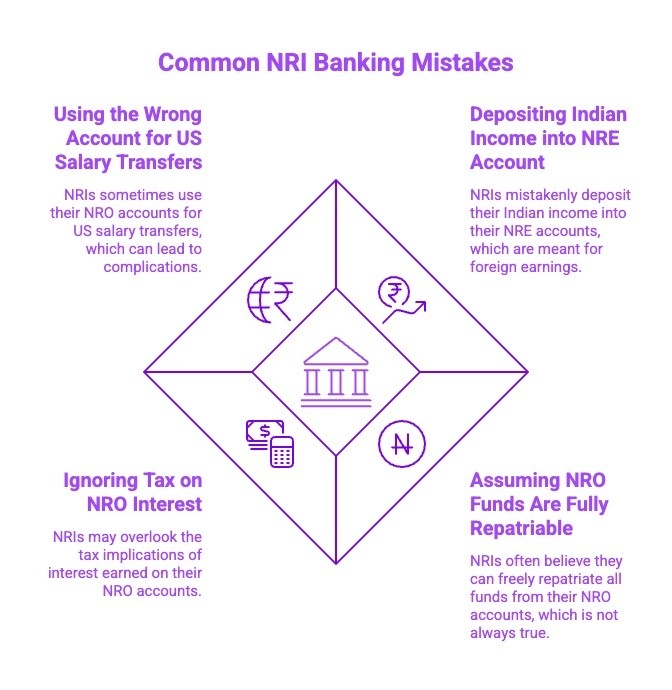
Many NRIs misunderstand the operational and tax differences between NRE and NRO accounts, especially when transferring funds from the USA to India. These errors can result in compliance delays, tax complications, or restricted fund access. Below are common mistakes to avoid.
- Depositing Indian Income into an NRE Account: Indian income, such as rent or dividends, must be credited to an NRO account. Routing it to an NRE account violates regulatory guidelines.
- Assuming NRO Funds Are Fully Repatriable: NRO repatriation is capped at USD 1 million per financial year and requires tax documentation before transfer.
- Ignoring Tax on NRO Interest: Interest earned on NRO accounts is taxable in India and subject to TDS, unlike NRE accounts.
- Using the Wrong Account for US Salary Transfers: Sending US earnings to an NRO account reduces flexibility and may create unnecessary tax exposure.
Avoiding these mistakes ensures compliant and efficient US to India transfers.
Worried about transfer issues? Find out why a bank can reject a wire transfer and how to avoid costly delays.
Why Use Frex for Your US to India Transfers?
Choosing between an NRE and an NRO account is important, but selecting the right transfer partner for your NRO transfers is equally critical. Frex simplifies US-to-India remittances for NRIs, delivering speed, transparency, and regulatory compliance.
- Direct transfers to NRO accounts: Seamlessly send money from your US bank account to your NRO account in India, with full regulatory compliance and transparency.
- Transparent exchange rates: Access live rates close to the mid-market or Google rate and see exactly how much will be credited before confirming the transfer.
- Zero or lowest transfer fees: Send money with zero fees or some of the lowest fees available. Transfers can start from as little as $2 with no minimum transaction requirement.
- Fast transfers and same-day deposits: Enjoy instant transfers, express transfers at no extra cost, and same-day deposits for many US to India transactions.
- Secure and reliable platform: Built with 256-bit encryption, partnered with Plaid, and designed with strong fraud protection to keep your transfers safe.
- Fully licensed and compliant: Operates in compliance with FinCEN (USA) and follows FEMA and FIU India regulations for secure international remittances.
Download the Frex app on the App Store or Google Play today and send money to your NRO account quickly, securely, and with complete transparency.
Note: Frex currently supports transfers to NRO accounts.
Conclusion
Understanding NRE vs NRO is essential for NRIs managing money between the USA and India. The right account depends on whether your earned income is in foreign currency or arises from the sale of property, mutual funds, or other Indian sources. NRE accounts are suitable for foreign earnings with tax-free interest and full repatriation flexibility, while NRO accounts are required for managing income generated within India.
Before initiating an NRO to NRE transfer, it is advisable to seek professional advice from a chartered accountant or financial advisor. Choosing appropriate NRI services helps ensure compliant, smooth, and efficient US to India remittances.
Frequently Asked Questions
Are there any RBI rules I need to follow when transferring money from NRO to NRE?
Yes. The Reserve Bank of India permits such transfers up to USD 1 million per financial year. If you are wondering how to transfer funds from NRO to NRE, tax compliance under the Income Tax Act and proof of source of income are mandatory before approval.
What tax implications should I consider when moving money from NRO to NRE accounts?
Interest income earned in an NRO savings account is taxable in India. Before transfer, applicable income tax and capital gains must be settled. NRIs in the United States should review the Double Taxation Avoidance Agreement to reduce the risk of double taxation.
What documents or forms are needed for transferring funds between NRE and NRO accounts?
Banks require Form 15CA, Form 15CB, a PAN card, and documents confirming the source of income. Many account holders ask, “Can funds be transferred from NRO to NRE easily?” However, approval depends on complete tax documentation and Reserve Bank of India compliance.
What methods can I use to transfer money to NRE or NRO accounts?
You can use international transfers from a local bank in the United States to an NRE savings account or an NRO deposit account. If asking, “Can you transfer from NRE to NRO?” Yes, NRE to NRO transfer is generally permitted without limits.
Are there any limits on the amount I can transfer between NRE and NRO accounts?
NRO to NRE transfers are limited to USD 1 million per financial year. If you ask, “Can I move money from NRO to NRE?” the answer is yes, but only within prescribed limits and after income tax clearance.
How does transferring funds between NRE and NRO accounts affect my account balances?
When you move funds, the originating account balance decreases, and the receiving account increases in Indian currency. Many NRIs ask, “Can funds be transferred from NRO to NRE without impact?” However, taxes and compliance checks may reduce the final transferable amount.
Is it possible to move money from an NRO account to US banks?
Yes, funds can be repatriated to US banks within the USD 1 million annual limit. If you are considering whether you can transfer from NRE to NRO or move funds overseas, ensure that tax compliance and Reserve Bank of India guidelines are followed.
How to transfer fund from NRO to NRE?
To transfer funds from an NRO to an NRE account, you must submit documents such as Form 15CA, Form 15CB, PAN details, and proof of income source. Banks allow transfers up to USD 1 million per financial year after tax compliance and regulatory verification.
Can you transfer from NRE to NRO?
Yes, you can transfer from NRE to NRO without major restrictions. NRIs often move funds this way when they need to manage income or expenses within India. The transfer is generally straightforward and does not have a specific upper repatriation limit.
Can funds be transferred from NRO to NRE?
Yes, funds can be transferred from NRO to NRE accounts, but the process requires tax clearance and documentation. The Reserve Bank of India permits transfers up to USD 1 million per financial year once applicable taxes and compliance requirements are completed.
Can I move money from NRO to NRE?
Yes, you can move money from NRO to NRE after completing tax compliance and submitting required forms such as 15CA and 15CB. The transfer limit is USD 1 million per financial year under RBI guidelines for repatriation of eligible funds.




Leave a Reply