





Key Highlights
- Wire transfers use SWIFT and often include $25 to $50 sending fees, intermediary deductions, and exchange rate markups.
- Bank transfers through digital platforms typically offer lower fees, more competitive USD to INR rates, and clear upfront pricing.
- A wire transfer is one type of bank transfer, but not all bank transfers are wires.
- Wire transfers may take 1 to 5 business days, while many electronic transfers complete the same day or within 24 hours.
- Wires are commonly used for large business or contract-required payments.
- Bank transfers are usually more cost-efficient for family remittances, tuition, and recurring transfers.
- Frex offers zero extra transfer fees, competitive exchange rates, fast delivery, and clear INR payout visibility for US to India transfers.
India continues to lead the world in remittance inflows. In 2024, India received a record $129.1 billion in remittances, marking the highest share for any country since 2000, according to the World Bank.
With such large sums moving across borders, choosing the wrong transfer method can quietly reduce the amount your recipient receives. Traditional bank wire transfers often involve high sending fees, intermediary bank deductions, and exchange rate markups.
This guide explains wire transfer vs bank transfer in the context of sending money from the US to India. You will learn how traditional bank wires compare to modern electronic bank transfers, where hidden costs typically appear, and which option offers better speed, transparency, and overall value for your remittance needs.
What Is a Wire Transfer?
A wire transfer is a traditional bank-to-bank transfer sent through international payment networks such as SWIFT, Fedwire, or CHIPS. When you send money from a US bank to an Indian bank using a wire transfer, the funds typically move through several intermediary banks before reaching the recipient’s account.
For US-to-India transfers, wire fees usually range from $25 to $50 on the sending side. Intermediary banks may deduct additional charges during processing, and exchange rate markups can further reduce the final INR amount received. These costs are not always fully transparent upfront.
Wire transfers are commonly used for large transactions or formal business payments because they are secure and widely supported by banks worldwide. However, compared to modern digital remittance services, they often involve higher fees and slower processing times for regular personal transfers.
Still considering a traditional wire? Before you decide, explore this detailed guide on how to send a wire transfer to India from the USA to understand the exact fees, timelines, and process involved so you can choose the most cost-effective option with confidence.
What Is a Bank Transfer?
A bank transfer, in the context of US to India remittances, usually refers to an electronic bank transfer processed through a digital remittance platform rather than a traditional SWIFT wire.
More broadly, a bank transfer is a general category that can include ACH transfers, online bank payments, internal bank-to-bank transfers, and transfers initiated through financial platforms. Instead of sending money directly through multiple international banks, these platforms collect funds in the US and disburse INR locally in India.
In an electronic bank transfer vs wire comparison, the key difference is how the money moves. Many modern services use local payout networks in India, which helps reduce intermediary fees and often results in faster delivery. Fees are typically lower, and exchange rate margins are more transparent.
For individuals sending regular support, tuition payments, or monthly transfers, a direct bank transfer vs wire transfer often provides better cost efficiency and clearer pricing while still delivering funds directly into an Indian bank account.
Wire Transfer vs Bank Transfer: What Are the Key Differences?
Choosing between a wire transfer and a bank transfer can significantly affect how much money actually reaches India. While both methods move funds from a US bank account to an Indian bank account, the cost structure, speed, and transparency can differ sharply.
The table below breaks down wire transfers vs bank transfers specifically for US-to-India remittances, so you can clearly see where fees, exchange rate markups, and processing times make the biggest difference.
| Factor | Wire Transfer (Traditional Bank Wire) | Bank Transfer (Electronic / Digital Remittance) |
|---|---|---|
| Transfer Network | Sent via SWIFT through multiple intermediary banks | Often uses local payout networks in India |
| Sending Fees | $25 to $50 typical outgoing wire fee | Low flat fee or small percentage-based fee |
| Intermediary Charges | Possible deductions by correspondent banks | Usually, no intermediary deductions |
| Exchange Rate | Often includes hidden markup on USD to INR | More competitive and transparent rates |
| Total Cost Impact | Higher overall cost due to fees + FX markup | Typically lower overall cost |
| Speed | 1 to 5 business days | Same day or within 24 hours in many cases |
| Convenience | May require a branch visit or detailed setup | Fully online or app-based |
| Tracking | Limited visibility once processed | Real-time tracking and upfront fee display |
| Reversibility | Difficult to reverse once processed through SWIFT | Some platforms allow cancellation before payout |
| International Support | Widely supported across banks globally | Available for many countries but depends on the service provider |
| Best For | Large business payments or formal transactions | Family remittances, tuition, recurring transfers |
Want to know when you can get even better value on your US to India transfer? Check out this handy guide on the best time to send money to India from the USA to help you plan smarter and stretch every dollar further.
How Do Costs Compare Between a Wire Transfer and a Bank Transfer?

When comparing wire transfer vs bank transfer for US to India transfers, the total expense is not limited to the visible fee. The true cost includes transfer charges, possible intermediary deductions, and the exchange rate applied to convert USD to INR. These combined factors determine how much money actually reaches the recipient.
1. Cost of a Wire Transfer
A traditional wire transfer from a US bank typically involves multiple layers of charges. Some are clearly stated, while others are embedded in the exchange rate.
Common cost components include:
- Usually, a $25 to $50 charged by the sending bank as an outgoing wire fee.
- Possible deductions by intermediary or correspondent banks that help route the transfer internationally.
- Occasional receiving bank charges are applied by the Indian bank when the funds arrive.
- An exchange rate markup of around 2–4% often added to the USD-to-INR conversion rate, which can reduce the final amount received.
2. Cost of a Bank Transfer
In a direct bank transfer vs wire transfer comparison, electronic bank transfers processed through digital remittance platforms are often structured to minimize layered charges.
Typical cost elements include:
- Lower flat fee or small percentage-based fee
- No intermediary deductions in most cases
- More competitive and transparent USD to INR exchange rates
- Clear display of the final INR payout before confirmation
Because many digital transfers use local settlement networks in India, unnecessary intermediary charges are usually avoided. The biggest cost advantage often comes from better exchange rate transparency, which can result in a higher final payout.
Curious about what can go wrong with a traditional wire? Read this clear breakdown on whether a bank can reject a wire transfer to learn common pitfalls and how to avoid delays or returned payments.
How Do Speed and Processing Times Compare?

For many people sending money from the US to India, timing is just as important as cost. Whether it is tuition deadlines, family support, or urgent expenses, transfer speed can influence which method makes more sense.
1. Speed of a Wire Transfer
Traditional wire transfers move through the SWIFT network and may pass through one or more intermediary banks before reaching India.
Typical timelines include:
- 1 to 5 business days for completion
- Possible delays due to compliance and anti-fraud checks
- Slower processing around US or Indian banking holidays
- Cutoff times that may push transfers to the next business day
Because multiple institutions may handle the transaction, delays can occur at different stages of processing.
2. Speed of a Bank Transfer
In an electronic bank transfer vs wire comparison, digital remittance platforms are often structured for faster settlement.
Common speed advantages include:
- Same-day or next-business-day delivery in many cases
- Faster INR credit due to local payout networks
- Fewer intermediary touchpoints
- Real-time status tracking through online dashboards or apps
For routine US-to-India remittances, electronic bank transfers are often faster and more predictable, especially compared to traditional SWIFT-based wires.
Sending money to India as an NRI? Explore this practical guide on smart strategies for NRIs sending money to India to understand common challenges and how to make your transfers faster, more cost-efficient, and easier to manage.
How Do Convenience and Setup Compare?
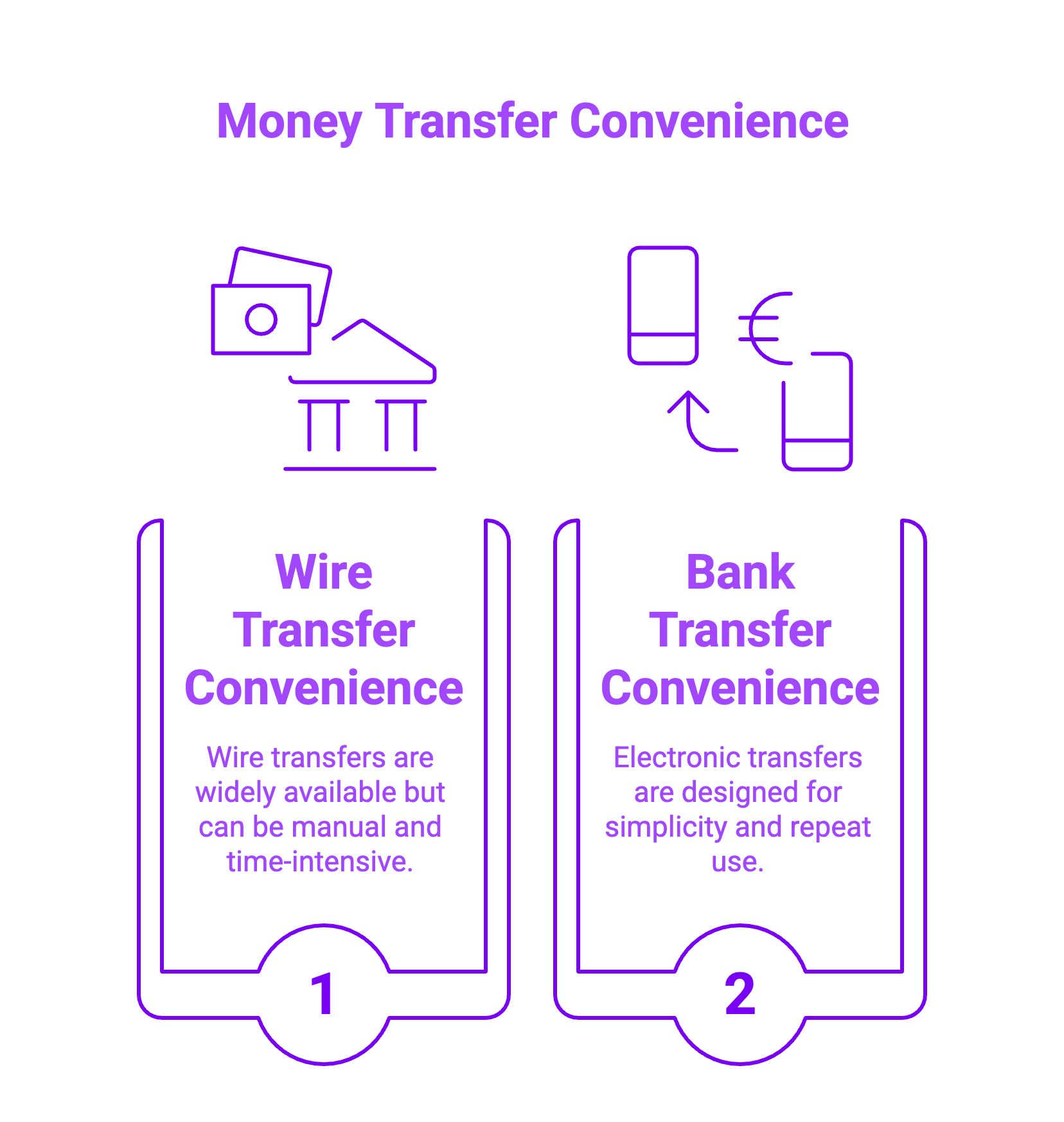
Beyond cost and speed, ease of use can significantly influence the choice between a traditional wire and a modern electronic transfer when sending money from the US to India.
1. Convenience of a Wire Transfer
Wire transfers are widely available through US banks, but the process can be more manual and time-intensive.
Typical experience includes:
- Visiting a bank branch in some cases
- Filling out detailed beneficiary information forms
- Providing SWIFT or BIC codes
- Strict cutoff times for same-day processing
- Limited flexibility for editing once submitted
For first-time transfers, the setup process can feel formal and documentation-heavy.
2. Convenience of a Bank Transfer
In a direct bank transfer vs wire transfer comparison, electronic transfers are generally designed for simplicity and repeat use.
Common convenience advantages include:
- Fully online setup through website or mobile app
- Saved recipient details for future transfers
- Instant transfer calculations before confirmation
- Fewer manual forms and paperwork
- 24/7 access without branch visits
For regular US to India remittances, digital bank transfers typically offer a smoother experience, especially for recurring monthly payments or family support transfers.
How Do Security and Reliability Compare?

Security is a major concern when sending money internationally, especially for US to India transfers involving large amounts.
1. Security of a Wire Transfer
Traditional wire transfers are processed through established banking networks and regulated financial institutions.
Key security features include:
- Transfers routed through the SWIFT network
- Oversight by US banking regulators
- Compliance checks for fraud and anti-money laundering
- Direct bank-to-bank settlement
Wire transfers are generally considered secure, but once processed, they can be difficult to reverse. Errors in beneficiary details may also cause delays or complications.
2. Security of a Bank Transfer
Electronic bank transfers processed through licensed remittance platforms are also regulated and designed with security in mind.
Common protections include:
- Encryption of transaction data
- Regulatory compliance in both the US and India
- Two-factor authentication and identity verification
- Real-time transaction monitoring
In a local bank transfer vs wire transfer comparison, both methods are secure when handled by regulated institutions. The key difference lies more in cost and processing structure than in baseline safety.
When Should You Use a Wire Transfer vs a Bank Transfer?
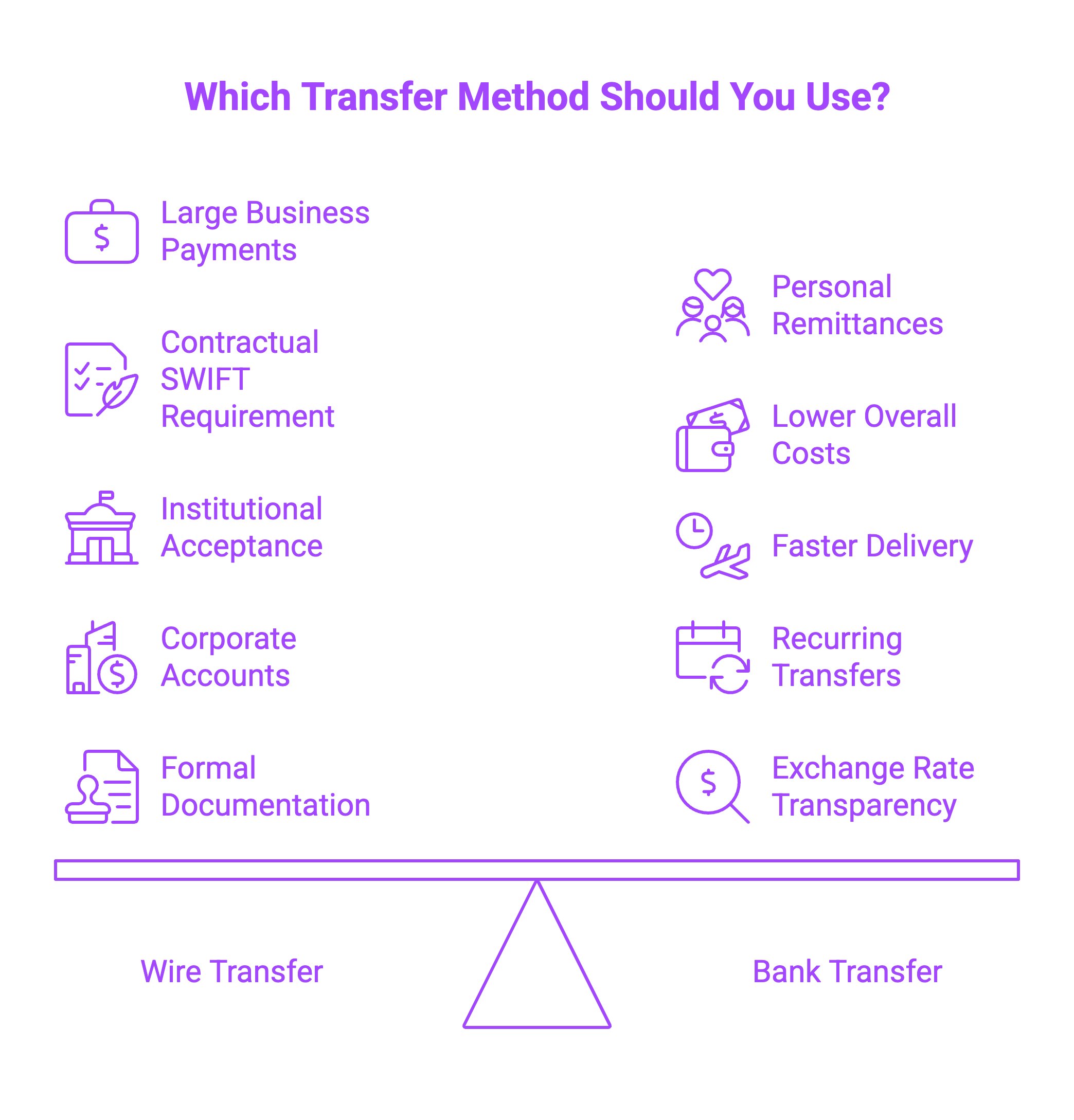
Choosing between a traditional wire and a modern electronic bank transfer depends on the purpose, urgency, and amount of your US to India transfer.
When a Wire Transfer May Make Sense
A wire transfer can be appropriate in more formal or high-value situations where traditional banking channels are preferred.
You might consider a wire transfer if:
- You are sending a large business payment
- A contract specifically requires a SWIFT wire
- The recipient institution only accepts international wires
- You are working directly with corporate or institutional accounts
- Formal banking documentation is required
In these cases, the higher cost may be justified by institutional requirements.
When a Bank Transfer Is Often the Better Option
For most personal remittances from the US to India, electronic bank transfers are typically more practical.
A bank transfer is often suitable if:
- You are sending family support or monthly remittances
- Paying tuition or rent in India
- Making recurring transfers
- Looking for lower overall costs
- Prioritizing faster delivery and exchange rate transparency
In a bank deposit vs wire transfer comparison, digital bank transfers often deliver more INR for the same USD amount due to lower fees and better exchange rates.
Want to save more on your remittances? Check out this simple guide on how to transfer money to India from the USA without fees to learn practical ways to reduce your total cost.
Why Frex is a Smarter Choice for US-to-India Transfers?
If you are comparing wire transfer vs bank transfer for sending money from the US to India, Frex offers a purpose-built alternative focused on lower costs, faster delivery, and full transparency.
Here is how Frex stands out:
- Zero extra transfer fees, so you avoid the high outgoing wire charges common with banks
- Competitive USD to INR exchange rates designed to maximize the final payout
- Fast transfers, with many transactions reaching Indian bank accounts quickly
- Upfront pricing clarity, showing the exact INR amount before you confirm
- Secure and compliant platform with strong verification and transaction monitoring
- No minimum transfer requirement, making it suitable for both small and large remittances
For regular family support, tuition payments, or recurring transfers, Frex combines the convenience of a direct bank transfer with better cost efficiency than most traditional wire options.
Final Words
When comparing bank-to-bank transfer vs wire for US to India remittances, the key difference lies in total value delivered. Wire transfers are reliable but often include higher fees and exchange rate markups that reduce the final INR received.
Modern bank-to-bank transfers typically offer lower overall costs, faster delivery, and clearer pricing. For regular family support, tuition, or recurring payments, they are often the more efficient choice.
If a formal SWIFT payment is required, a wire may be necessary. For most personal transfers, however, a digital bank-to-bank transfer usually provides better transparency and better value.
Frequently Asked Questions
How does an ACH transfer differ from a wire transfer?
An ACH transfer moves funds through the automated clearing house and ach network for domestic transfers in the United States. A wire transfer sends money directly between different banks using payment instructions. Wire transfers are faster but involve wire transfer fees.
Is a direct bank transfer the same as a wire transfer?
A direct bank transfer is not always a wire transfer. It may use ach transactions for domestic payments. A wire transfer moves money directly from the sender’s bank to the recipient’s bank, often used for international transfers.
How long does a wire transfer take compared to a bank transfer?
Domestic wire transfers often process the same business day, while international wire transfers may take one to five business days. Bank transfers using ACH payments typically take one to three business days within the United States, depending on the transfer type and the recipient’s bank.
Should I do direct deposit or a wire transfer?
Direct deposit uses ACH transactions through the Automated Clearing House and works well for domestic payments like salaries or bill payments. A wire transfer is better for urgent or international transactions, but it includes wire transfer fees and higher processing costs.
Does Stripe accept bank transfers?
Stripe supports electronic payments, including ACH payments in the United States. Businesses can accept bank transfers directly into a checking account. Availability depends on the payment methods enabled and the country. International payments may require additional information and account verification.
Are wire transfers over $10,000 reported to the IRS?
Banks and credit unions must report certain transactions over $10,000 to comply with federal regulations. This reporting applies to cash transactions and specific transfer types. International wire transfers may trigger compliance checks depending on the amount of money and payment instructions.
What are the disadvantages of electronic funds transfer?
Electronic transfer of funds can involve processing delays, limited reversibility, and dependency on accurate account information. Errors in the recipient’s bank account number or account details may cause failed domestic payments. Some transfer types also include transaction limits or processing restrictions.




Leave a Reply